
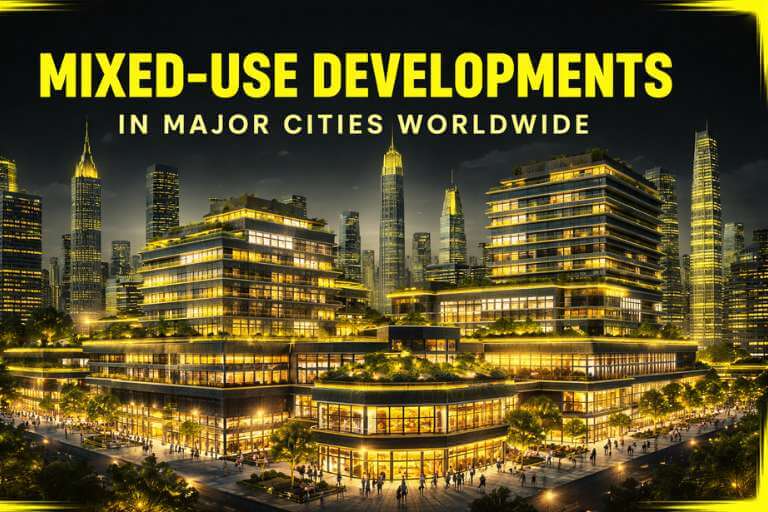

A New Urban Lifestyle Shaped by Mixed-Use Development
In many urban areas, older buildings and neglected land often fall into disuse, creating an opportunity to upgrade both public spaces and local amenities. Well-planned mixed-use areas bring a community together and improve sociability among residents, employees, visitors, and tourists. These environments often lead to a better quality of life and create a positive impact on the wider city. Global firms such as Chapman Taylor, known as a world leader in design of complex mixed-use developments, often focus on creating meaningful experiences through diverse options and a well-considered mix of uses. Their goal is to build vibrant environments and successful environments where people can live, work, shop, stay, eat, socialise, and remain entertained.
Table of Contents
The global rise of mixed-use projects has helped revitalise many cities, especially during the mixed-use development boom of the last decade. Developers frequently promote live work play destinations, with new developments breaking ground in one country after another each month across major cities. This growth is supported by strong demand for integrated projects, partly influenced by migration shifts and lifestyle changes after the COVID-19 pandemic, which also increased interest in suburban locations and nearby suburbs. Experts like Robert Blaser, principal and design practice leader at Michael Graves Architecture, highlight this design trend of building connected communities and attractive destinations. Industry voices such as Greg Freedman, co-founder of the development firm BH3, writing for Commercial Property Executive, describe the stronger together formula of mixed-use as recession resistant, especially in the hottest markets with high growth populations and industries like STEM—science, technology, engineering, and math—along with creative businesses that thrive in dynamic 24 hour cities like New York, Miami, and Los Angeles.
Competition for innovation in cities has also accelerated interest in mixed-use planning. When Amazon HQ2 requested bids for a new site location before the year end, many major cities proposed ambitious plans combining business districts and lifestyle zones. Reports from Construction Dive described the six largest developments, including a mammoth proposed project integrating housing, offices, and sports venues. These examples show how this market segment has become central to modern urban development, shaping strategies in urban design, urban planning, and zoning classification. Such developments integrate residential, commercial, cultural, institutional, and entertainment functions into a single ecosystem with integrated functions. This integration may occur within a single building, a block, a neighborhood, or even influence the zoning policy of an entire city, guided by an administrative unit, a private developer, a governmental agency, or even a quasi governmental agency.
Many modern projects combine new construction with reuse of an existing building or redevelopment of a brownfield site, often using a combination of approaches. A well-known European example involves Lacaton & Vassal, whose transformation project converted an administrative center into a residential office building in Vannes, a medieval town in Brittany in northwest France. The effort was supported by state policy using state owned land for housing development. In 2023, the French State launched a call for expressions of interest to redevelop an administrative complex that hosts state services. The consultation involved the City of Vannes, developers GReeStone Immobilier and Grand Ouest Immobilier, and an architectural team led by Anne Lacaton and Jean Philippe Vassal, winners of the 2021 Pritzker Prize, along with Emmanuelle Delage Architecte. The project worked closely with the city government to strengthen resilience, reduce the carbon footprint, and focus on renovating rather than demolishing buildings.
Vertical Mixed-Use Development
One of the most common models is vertical mixed-use development, where stacked functions are placed within a single building. In this structure, commercial spaces such as retail stores and restaurants often occupy the ground floor, creating active street life. Above them, offices are typically located on the middle floors, while residential apartments fill the upper levels. This arrangement shows how a smart design maximizes land use, especially where limited land exists in dense urban areas.
Because everything is located within one structure, walkability improves and people can access services through single building access. The concept relies on integrated building functions, forming a clear vertical development model that carefully organizes different building levels. Through mixed functions stacking, cities can increase urban density while maintaining strong space optimization.
Horizontal Mixed-Use Development
Another approach is horizontal mixed-use development, which spreads functions across separate buildings within the same area of a large complex. In a horizontal mixed development project, planners might combine residential homes, office buildings, retail stores, and entertainment facilities so that all services remain within comfortable walking distance. This model is especially common in suburban areas or larger urban districts where more available land allows wider design flexibility.
The development layout in such projects usually depends on careful district planning, where each part of the mixed-use complex connects smoothly with others. Strong neighborhood integration becomes essential because planners must balance land availability with thoughtful spatial distribution. When done properly, this design produces lively districts where daily activities occur within a well-connected environment.
Live-Work Spaces
A smaller but highly practical model is live-work spaces, a hybrid approach within mixed-use development that combines living environments and working environments in carefully designed spaces. Usually, a small commercial area occupies the lower level, functioning as a studio, workshop, or office, while the living area sits upstairs or in adjacent spaces. This setup attracts entrepreneurs, freelancers, and small business owners who prefer a convenient work-life balance.
Because it removes the need for daily commuting, the arrangement supports a cost-effective work-life balance. This form of residential work integration has become especially valuable for people running home business spaces, blending productivity and comfort in one location.
Integrated Mixed-Use Development
At the largest scale, integrated mixed-use development appears as a larger scale project combining residential spaces, commercial spaces, and recreational spaces along with additional functions like educational institutions, healthcare centers, and cultural hubs. These city scale projects often operate like a self-sustaining ecosystem inside a single district, providing housing, entertainment, healthcare services, and other essential services for residents.
Because daily needs are located nearby, such projects support long distance travel reduction, which improves sustainability and convenience. Through coordinated urban district development supported by integrated infrastructure, these developments create balanced communities where work, leisure, and daily life exist within the same urban system.
Five of Our Current Mixed-Use Projects That Are Regenerating Cities All Over the World
Across the world, our mixed-use projects are actively regenerating cities and shaping urban regeneration in key international cities. These global projects focus on city transformation by combining development projects and mixed-use developments to encourage urban revitalisation. From architecture projects to global urban development initiatives, each project contributes to city redevelopment, introducing modern infrastructure while integrating local culture, lifestyle, and commerce into thriving districts.
Through these regeneration initiatives, our mixed-use projects are not only transforming physical spaces but also creating vibrant urban environments where communities thrive. They demonstrate how strategic planning in urban development can revitalize neighborhoods, boost local economies, and deliver lasting social and economic value across the world.
Madinah Hub, Madinah, Saudi Arabia
The Madinah Hub in Madinah, Saudi Arabia presents a concept aerial view of a dynamic urban district that was under construction in December 2023. Designed around the Knowledge Economic City masterplan, it features a retail core, leisure core, and hospitality core. The development includes a shopping venue, dining venue, and entertainment venue, located just 6km from the Prophet’s Mosque and close to the Haramain high-speed railway station. Covering 129,000m², the project integrates a shopping centre, entertainment centre, glass-covered atria, and pedestrian streets lined with shops, restaurants, cafés, cinema, and family entertainment centres.
Dolmen City, Islamabad, Pakistan
Dolmen City in Islamabad, Pakistan, designed by Chapman Taylor, aims to transform Islamabad with a 108,000m² GLA mixed-use development known as Dolmen City DHA Islamabad. This vibrant project enhances urban living by offering community, convenience, and amenities for both residents and visitors. Strategically positioned and nestled within the city, the development blends lush forests and nature with modern living. Its design principles align with the 15-Minute City, enabling residents and users to access services within a 15-minute walk, reducing reliance on long commutes and supporting a sustainable environment.
The Development Comprises Several Key Components
The development components include a shopping mall, designed as a world-class shopping destination with aesthetically pleasing facades, diverse retail options, and engaging leisure activities for individuals and families. Abundant natural light in interior spaces creates a welcoming atmosphere and a functional environment that enhances an enjoyable atmosphere. An outdoor street, external shopping street, and F&B street form a vibrant hub where friends and families gather in a themed environment full of charm.
Topkapı 29, Istanbul, Turkey
Topkapı 29 in Istanbul, Turkey, currently under construction, revitalizes post-industrial areas near Topkapi Palace in central Istanbul. Previously home to auto repairs and rundown streets, the suburb now benefits from urban regeneration through a multi-function mixed-use destination. The project includes shopping streets, offices, a five-star hotel, and residences, all integrated into a lifestyle centre. Its direct access to the E5 highway, a new metro station, and well-planned transportation links connects the west of the city. Landscaping, public parks, residential communities, masterplan, landscaped urban spaces, building forms, event plazas, U-shaped covered streets, multi-level event plazas, central buildings, boutique shopping, markets, restaurants, and leisure facilities ensure a fully functional and dynamic district.
Soapworks, Manchester, UK
Soapworks in Manchester, UK, located in Salford, is an iconic Soapworks transformation project worth £200 million on an 8.5-acre site. This mixed-use expansion project creates a welcoming, sustainable, vibrant mixed-use community. Designed by Chapman Taylor, it integrates existing uses, amenities, and facilities for both occupants and the wider community. The masterplan includes three residential buildings with 450 contemporary homes and modern workspace typologies, involving refurbishment of a vacant building. A multi-level transportation hub provides car parking, cycle parking, and improved connectivity through pedestrian routes and cycle routes, achieving sustainable targets and environmental targets for the Salford community.
Huzhou Wuxing Young City, Wuxing, China
Huzhou Wuxing Young City in Wuxing, China started as a competition project to create a mixed-use development that harmonizes with the natural beauty and architectural heritage of Huzhou. The design inspiration draws from Taihu Lake, mountains, and rivers, incorporating thematic elements into a western plot featuring commercial spaces, hotel spaces, and a mix of traditional and modern architecture. Waterfront commerce, hotels, and landscape views create immersive urban experiences.
The Largest Projects Underway in the U.S
Some of the largest projects in the U.S. are redefining development building and urban living. One example is a 320,000-square-foot biotech lab facility at 1229 W Concord Place, designed by San Francisco-based architecture firm, Gensler, and topped off with completion next year. The developer, Sterling Bay, has also created project roadways and a 1-mile riverwalk along a natural river wall. In Chicago, The Steelyard features a residential portion and commercial portion, which broke ground in 2022 as part of the Lincoln Yards full buildout plan with 6,000 residential units, including 20% affordable units. Initial plans included an 18,000-seat soccer stadium and Live Nation entertainment district, though a rejected proposal by Chicago Alderman Brian Hopkins led to redesigns. The development site also includes 40% park space, athletic fields, small entertainment venues, and residential properties integrated with adjacent development.
Other key developments include 2100 N Southport, a mass timber building completed in 2023, and 2301 N Kingsbury, still in planning stages. In Dallas, The Central, led by StreetLights Residential and De La Vega Development, is a $2.5 billion project that broke ground in October 2022. It involves demolition challenges at the Affiliated Computer Services building, famously called the Leaning Tower of Dallas, with press coverage noting the incomplete demolition and lopsided structure over 15 days.
Use in North America vs. Europe
In North America, mixed-use patterns were shaped by early human settlements, industrialization, and governmental zoning regulations that enforced separated functions, placing manufacturing and residential areas apart. Concerns about public health, protection of property values, and avoiding negative externalities like air pollution, noise pollution, and light pollution guided zoning codes. Influential urban planners like Robert Moses, New York City Parks Commissioner, advocated superhighways and city functions separation, often dividing neighborhoods. Critics like Jane Jacobs, a mixed-use zoning proponent, argued for organic streetscapes, diverse streetscapes, and vibrant streetscapes. By the 1990s, a resurgence in mixed-use zoning highlighted its desirability for combating urban sprawl and enhancing economic vitality.
Mixed-Use Development Benefits
Mixed-use developments offer significant advantages for cities, providing employment opportunities, housing opportunities, and enhancing projects in established downtown districts. By leveraging public transit systems and underutilized or undervalued land, including former heavy industrial land, developers can repurpose land, increasing land values and property values. These projects encourage housing variety, improve density and affordability, and create a balance between supply and demand for multifamily housing and single-family housing compounds. Ultimately, jobs, housing, and vibrant housing districts benefit from the strategic development of mixed-use spaces.
Economic
The economic benefits of mixed-use developments are substantial. By creating employment opportunities alongside housing opportunities in established downtown districts, developers can repurpose undervalued land and underutilized heavy industrial land, increasing land values and property values. These projects support a housing variety that improves density, affordability, and a supply-demand balance for multifamily housing and single-family housing compounds, while generating local jobs and strengthening economic resilience.
Social
Socially, developments like Pentagon Row in Arlington, VA, with apartments above ground floor retail and an ice skating rink, demonstrate how development patterns promote live work play lifestyles. By transforming buildings and neighborhoods into multi-use entities, these projects improve efficiency, productivity, and quality of life. Amenities such as gyms, restaurants, bars, and shopping create mixed-use neighborhoods fostering community and socialization among employees, visitors, and residents. Unlike single use districts, which operate 9am–5pm, mixed-use streets remain active eighteen hours a day, increasing neighborhood safety and promoting longer streets activity.
Environmental
Mixed-use neighborhoods and mixed-use buildings improve adaptability to changing social and economic environments, such as the COVID-19 pandemic, where New York retailers relied on commercially oriented blocks with an audience of passersby. Multiple functions in a single building development enhance resiliency, attract visitors, and maintain footfall. Studies, including one in Guangzhou, China published in the Journal of Geographical Information Science, show that mixed-use districts reduce traveling distances with micro-mobility, pedestrian infrastructure, and bike-friendly infrastructure, connecting housing, workplaces, retail, businesses, amenities, and destinations while reducing carbon emissions and car traffic in metropolitan areas.
Mixed-Use Development Architecture: Creating Efficient Spaces
Mixed-use development architecture focuses on designing efficient spaces that support the project success of mixed-use development projects. Effective design ensures traffic flow is smooth while promoting space maximization and seamless integration of residential, commercial, and leisure areas. By emphasizing functions integration, planners make sure that work proximity, home proximity, and leisure proximity are optimized, allowing residents and visitors to live, work, and enjoy entertainment without long commutes. Leading architecture firms prioritize these principles to enhance community building, encourage interaction, and increase convenience for all users.
Key Features of Low-Rise Mixed-Use Development
The low-rise development features focus on smaller scale developments with fewer units, fostering a close-knit community. With community focus, neighborhood integration, and walkability, residents enjoy easy access to amenities like shops, cafés, offices, green spaces, communal areas, gardens, and parks, enhancing overall resident quality of life.
The Future of Mixed-Use Development
The future of mixed-use development is closely tied to growing cities facing urban expansion challenges. Combining residential spaces, commercial spaces, and recreational spaces reduces travel time and lowers environmental impact, while creating vibrant communities and connected communities. With mixed-use architecture, future urban planning prioritizes walkable cities, bike-friendly cities, and sustainable urban living, ensuring functional, lively, and environmentally responsible neighborhoods.
Conclusion
mixed-use developments have become a cornerstone of modern urban planning, combining residential, commercial, and leisure spaces into efficient spaces that promote community interaction, convenience, and sustainability. From low-rise projects in suburban districts to vertical mixed-use developments in major cities worldwide, these projects maximize land use, reduce travel times, and support economic growth while enhancing the quality of life for residents, visitors, and employees. By integrating functions, fostering social connections, and encouraging environmentally conscious design, mixed-use architecture provides a blueprint for the future of urban living, creating vibrant, connected, and resilient communities across the globe.

Leave a Reply