
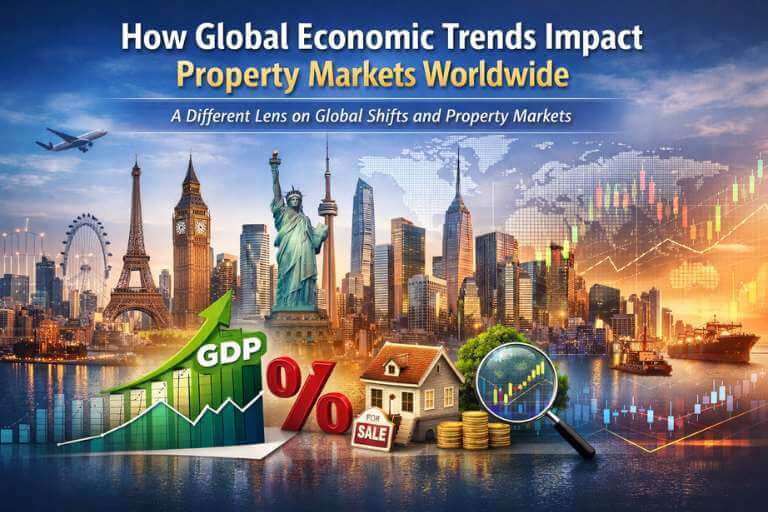

A Different Lens on Global Shifts and Property Markets
In my experience working closely with buyers, sellers, and investors, I’ve seen how reports from PwC and the Urban Land Institute reveal patterns that stretch across Europe, the United States, Canada, and Asia Pacific. Through interviews with senior property investment professionals and detailed regional surveys, one clear key indicator stands out—market sentiments shape the direction of global real estate. These insights show how global events create a profound impact and often a far-reaching impact on the international real estate space, influencing market trends, property values, and overall investor sentiment.
Table of Contents
From my perspective, the real story lies in how external forces like economic downturns, geopolitical tensions, and advancements in digital innovations push people to rethink how they invest in property across the world. Platforms like DarGlobal often highlight how to navigate and thrive in this ever-evolving industry, especially when changes come fast. If you follow any serious blog or track key global events, you’ll notice how real estate markets shift alongside investment strategies, giving a broader overview of the international real estate market and ongoing international trends.
What fascinates me most is how properties are built, bought, sold, and valued differently depending on the economy and global trends. The real estate industry operates through both direct and indirect channels, influenced by economic development, interest rates, foreign investment, demographic shifts, and government policies. It both reflects and contributes to the global economy, meaning it is constantly impacted by the ebb and flow of global economic trends. Understanding these implications is critical for developers, homeowners, and anyone tracking long-term factors that impact the industry.
When analyzing the economic impact on real estate values, I always look at macroeconomic factors like Gross Domestic Product, GDP, interest rates, and employment data. These are essential for assessing the economic health of a region and, consequently, its real estate market. During periods of economic growth, increased GDP, higher employment rates, and rising consumer confidence boost demand for housing, driving up property values. But in times of economic downturn, when indicators falter or decline, we often see property values drop sharply.
The rhythm of economic cycles—from boom to recession and into recovery phases—clearly illustrate this impact. In a boom, real estate investments flourish with heightened economic activity and strong consumer spending. In recessions, property values may plummet as unemployment rises and disposable income decreases. Yet, I’ve personally seen how recovery phases create opportunities for strategic investments, as markets stabilize and property values gradually increase. This deep understanding of cycles helps investors predict market movements and adjust their strategies. Ultimately, the real estate market acts as both a reflection and contributor to the global economy, being perpetually influenced by ebbs and flows, interest rates, inflation, geopolitical stability, and technological advancements—all powerful forces shaping the economic landscape that leave a lasting mark on real estate values, investment strategies, and market dynamics.
Sweden’s Hidden Pressure Points in Property
Looking at the real estate sector in Sweden, I’ve noticed a unique pattern where its contribution to the national GDP sits around 22-23%, yet the real tension comes from households being nearly twice as indebted as the European average. A large share of wealth is tied to property, with almost 80 percent of household debt linked to housing, and in the past year, aggressive interest rate increases driven by high inflation have really pressed finances to the limit, directly impacting the real estate sector in ways that are easy to miss unless you’ve tracked these shifts closely.
Canada’s Market Gridlock and Shifting Demand
From what I’ve observed, the Canadian housing market shows a complex contribution to the national GDP, yet rising housing prices have made many buyers hesitant, especially with slowed developments and ongoing interest rate uncertainty. A growing labor gap in the real estate sector, combined with strong population growth, adds pressure, and according to BMO research, the country’s high-growth immigration strategy was estimated by the government to support demand, though conditions have stressed the system over the last 16 months. If you list current challenges, oversupply concerns act as a dampener, making sellers reluctant while only about one percent actively moves in this market uncertainty, creating a logjam in housing. Despite a rise in interest rate hikes, many deals stay on hold, even as some are close to happening, with new arrivals delaying purchases, and barely three percent ready to pull the trigger, while prices in some areas have adjusted by nearly 13%.
Germany’s Costly Transition and Buyer Advantage
In Germany, the real estate sector still holds a strong contribution to the national GDP at around 20%, but what stands out to me is how the shift in the German real estate space has clearly turned into a buyer’s market. From my experience tracking European data, guidance from the European Commission around strict climate goals is pushing major change, with nearly 60 percent of Germany’s housing stock needing to be renovated in the next 10 years. This sharp focus on energy efficiency has become one of the top priorities for buyers, especially those thinking long-term.
At the same time, this green transition is starting to increase costs and widen the price gap between houses that already meet climate goals and those that do not. I’ve seen many owners struggling, as a large number of properties are still not up to scratch, making it harder to cope with falling values in older units, while newer, compliant homes hold their ground much better.
Australia’s Supply Strain and Market Reset
In Australia, the real estate sector continues to show a strong contribution to the national GDP at around 13%, but the real story lies in the ongoing housing crisis driven by a clear lack of supply. From what I’ve seen on the ground, short-term housing demand is sharply rising, mainly due to immigration returning to pre-COVID levels, while the country faces some of the lowest supply rates among developed nations, with only about 400 dwellings per 1,000 people. This imbalance is pushing prices to rise, although there are early signs that the market is slowly entering a recovery mode.
At the same time, challenges like construction company collapses have damaged overall market confidence, making many cautious, even as cooling inflation and a possible peak in interest rates begin to shift sentiment. In my experience, these moments often create hidden opportunities, especially with good rental yields attracting attention across the southern hemisphere, and the summer selling season expected to boost transactions in the coming months.
Thailand’s Supply Pressure and Foreign Demand Balance
In Thailand, the real estate sector shows a steady contribution to the national GDP at around 8-10%, but the deeper story lies in the domestic residential property development market, which is heavily supported by local conglomerates driving investment into new real estate projects, especially in the central Bangkok region. From what I’ve observed, this push to create more supply has led to an oversupplied market, increasing exposure to balance sheet stress in the near-term, particularly for developers trying to manage rising costs and slower absorption rates.
At the same time, Thailand condominium sales remain supported by international investors from China and Russia, along with a recovering tourism sector that brings in more buyers. Many experts I’ve worked with expected this trend to continue and support residential sales, especially in the fourth quarter, despite growing concerns around bond payment defaults among real estate developers seen in early 2023. With the uncertain global economy, this delicate trend is likely to continue, keeping the market balanced between risk and opportunity.
Malaysia’s Tight Margins and Supply Overhang
In the Malaysian landscape, the real estate sector has a smaller contribution to the national GDP, sitting around 2-3%, but the real pressure comes from how local property firms are dealing with oversupply in the market. From what I’ve seen, many are trying to clear the existing overhang before moving forward, which has made property developers more cautious, often delaying the launch of new projects despite demand slowly rising in certain areas.
Indonesia’s Stability Amid High Rates
In Indonesia, the real estate sector shows a strong contribution to the national GDP, around 15%, reflecting how real estate, construction, and property industries are crucial to the country’s GDP. From my experience monitoring the current market, even in a high interest rate environment, new home demand continues, with prices in Indonesia forecast to remain largely stable over the next year. This is supported by domestic banks that maintain steady mortgage rates, helping real estate developers keep selling price per square meter affordable while still ensuring profitability.
Developers are also maintaining market momentum by reducing the size of homes, making units more accessible and appealing. In my observation, this strategy allows the real estate sector to stay resilient, balancing demand with practical pricing while ensuring that growth continues even under tighter financial conditions.
Hong Kong’s Cooling Market and Rising Challenges
In Hong Kong, the real estate sector contributes around 8-10% to the national GDP, but the Hong Kong real estate sector has been impacted by rising interest rates and a broader slowdown in the economy, affecting buyer confidence. From what I’ve observed, house prices are in a downward spiral, with a large inventory of unsold units reaching the highest level since 2007. Population trends have worsened this, having dropped for the third straight year due to a net outflow of about 60,000 residents in 2022, which has cooled what was once historically one of the hottest markets globally.
This weakening demand is visible in seasonally adjusted, quarter-to-quarter comparison data, as real GDP showed a fall of 1.3 percent in Q2 2023. From my perspective, this combination of declining population, excess supply, and rising borrowing costs has created a unique challenge for developers and investors in Hong Kong, signaling that the market may remain subdued until confidence returns and economic conditions stabilize.
Key Events Shaping Global Real Estate
In global real estate markets, investors and homeowners know that the sector is highly sensitive to major events, which can quickly shape economies and alter investment trends. From my experience, understanding these key global events is essential to make informed decisions in an ever-evolving landscape, as shifts in politics, finance, or social developments often ripple through international real estate markets.
Major global events—from economic crises to geopolitical changes—can influence buyer confidence, creating periods of rapid growth or sudden caution. I’ve observed that those who track these patterns closely are better positioned to navigate risks, anticipate market movements, and adapt strategies effectively, making their investments more resilient in the face of global uncertainty.
Influence of Political and Regulatory Factors
From my experience observing property markets across different countries, government policies and tax laws play a key role in shaping real estate markets. Favorable policies can attract investors and boost confidence, while sudden regulatory changes often slow down the market by creating uncertainty. Political stability is equally important, as instability discourages long-term investments. Countries that maintain clear foreign investment regulations and predictable legal frameworks tend to see more steady growth in property demand, highlighting how closely politics and rules are tied to market performance.
Geopolitical Influence on Property Markets
In my experience, geopolitical stability plays a crucial role in maintaining confidence among investors and ensuring the health of real estate markets. Events like political upheaval, political unrest, trade disputes, or foreign wars can quickly create uncertainty, impacting investment flows and market sentiment. When markets face volatility, the viability of new projects suffers, and real estate stakeholders must monitor global events closely to understand the possible consequences and potential impacts on their investments.
Stability allows markets to thrive, while uncertainty and volatility discourage long-term commitments. From my professional perspective, successful real estate stakeholders keep a close eye on international conflicts and global events, analyzing how shifts in stability or emerging uncertainty might lead to reduced investment flows or dampened market sentiment. Being proactive in tracking these changes is essential for protecting investments and ensuring the real estate industry continues to thrive despite external pressures.
Environmental Impact and the Green Revolution
In my experience, climate change and environmental sustainability are increasingly influencing real estate investment and development decisions. Properties that are designed with sustainable design and adhere to strict environmental standards are becoming more desirable, as tightening regulations push the real estate sector toward the green revolution. This shift presents new opportunities for innovation in construction and sustainability, shaping investment preferences and guiding which properties attract forward-thinking investors.
For real estate stakeholders, integrating environmental sustainability into projects is no longer optional but essential for long-term success. From my perspective, investment preferences now favor properties that meet high sustainability standards, offering a competitive edge in real estate investment and development. Adapting to these trends not only mitigates climate change impacts but also ensures that markets thrive by appealing to environmentally conscious investors.
Strategies for Thriving in Changing Markets
Understanding global economic trends and their impact on real estate requires constant vigilance and adaptability from investors and professionals in the sector. Staying informed about trends and potential impacts is key to navigating the market successfully. From my experience, diversifying investment portfolios and leveraging technology not only enhances operational efficiencies but also helps in focusing on sustainable development practices to meet evolving market demands.
Charting a Path for Future Growth
The interplay of global economic trends makes the real estate market increasingly complex and multifaceted, demanding the ability to adapt and anticipate shifts. From my experience, trends shaped by geopolitical events, global conflicts, trade policies, diplomatic relations, and sanctions can influence real estate market performance, as tensions often cause investors to pull back from unstable regions. Conversely, peace treaties and economic agreements can boost real estate transactions, highlighting how collective actions within politics directly define success in the real estate sector.
To continue thriving, investors and professionals must innovate in response to challenges, leveraging technology and focusing on sustainable development. Strategic investment decisions informed by a clear understanding of the global economic landscape and real estate market dynamics allow stakeholders to evolve with shifts, ensuring their presence remains resilient and profitable even when markets are volatile or rapidly changing.
Technology and Innovation in Real Estate
The real estate industry is fundamentally transforming due to technology and rapid advancements. Tools like AI-driven market analysis, VR property tours, blockchain-based smart contracts, and IoT-enabled smart homes are influencing real estate values and investment opportunities, making property transactions more efficient, transparent, and secure. From my experience, proptech startups and established players, like Australian real estate agency Barry Plant, are leading innovation by streamlining real estate operations, reshaping how professionals engage with buyers, tenants, and investors.
AI-powered solutions have also become essential tools for assessing economic impacts and forecasting market trends. For instance, in 2024, an AI-powered assistant named Grace interacts with prospective buyers and tenants, crafts listings, and answers inquiries, demonstrating how AI is changing the business by reducing manual work and improving service efficiency. Such technologies are vital for professionals aiming to evaluate property values accurately, even in a complex, multifaceted market.
Navigating Real Estate in a Changing World
Understanding global trends is essential for investors, developers, and homeowners aiming to make well-informed decisions in the real estate market. From my experience, staying informed and monitoring global movements allows stakeholders to predict shifts in the economy, lifestyle, and demand for homes that people want to live in or invest in. Projects designed to withstand market fluctuations, incorporating technology and sustainability, are more likely to deliver lasting value and remain attractive despite changes in economic conditions.
Leading companies like DarGlobal are strategically positioning their developments by aligning with global trends, integrating sustainable architecture, and selecting prime investment destinations. By collaborating with world-renowned brands, they create projects designed to stand the test of time while offering clients access to high-quality, future-proof properties. These approaches not only cater to luxury real estate demands but also expand exclusive portfolios and discover investment opportunities that remain attractive in evolving markets.
For investors and developers, maintaining awareness of patterns in worldwide economic trends and the decisions of politicians is essential to adjust strategies, manage risks, and take advantage of opportunities. By applying smart investment principles, focusing on long-term growth, and committing to excellence, the real estate market can continue redefining how projects are designed, sold, and experienced, ensuring they stand the test of time while meeting the needs of an ever-changing global environment.



Leave a Reply