
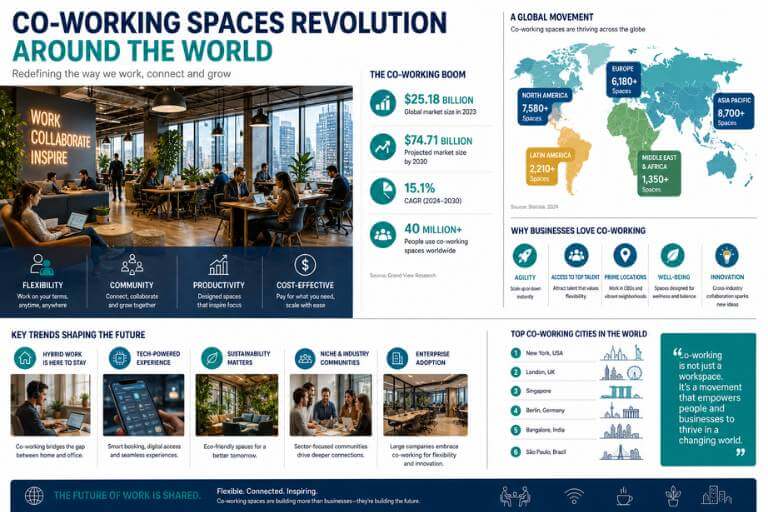

work has changed in a big way over time, and these days, the old model of rigid office setups with leases that are long and often soul-crushing—along with exhausting commutes—is fading fast. I’ve seen this shift personally, as more professionals are ditching the traditional office for something that offers flexibility, community, and real convenience. What once felt like a fringe idea has now become a global movement, quietly transforming how businesses, freelancers, and remote workers operate. In the aftermath of a global economic crisis, the way we see and define work has transformed, especially within the knowledge economy, where nonstandard forms of employment have become commonplace and highly individualised.
Table of Contents
The labour market today reflects a reality where urban professionals are part of a casualised, project-based, and often freelance workforce, something explored by Cappelli, Keller, 2013, and Osnowitz, 2010. To some extent, knowledge workers are now encouraged into finding new ways to live a more nomadic, sometimes precarious worklife, often within a fragmented professional context. From a literature review perspective, it’s an interesting phenomena to see the emerge and diffusion of coworking spaces, as they continue to spread and reshape everyday practices. What was once just a buzzword now carries increasingly high expectations for the improvement of socio-economic conditions for workers in the knowledge economy, echoing a vibe similar to Richard Florida and the rise of the creative class in 2002, seen as drivers of economic growth in the early 2000s.
Still, a more critical reflection shows that beyond the celebratory framework, many representations of coworking spaces need deeper analysis. To truly interpret the coworking phenomenon, we must look at the broader landscape of the knowledge labour market, where it is often connoted with the expectation of a new model of work rooted in a collaborative, sharing economy, as described by Botsman and Rogers, 2011. Yet, existing contributions offer little evidence to fully assess whether these practices lead to real skill enhancement or tangible empowerment for urban knowledge workers, or if they simply create an illusory enthusiasm that may reproduce inequalities and shortcomings similar to those seen in creative cities. A wide and diverse body of literature has flourished around this theme, engaging both academic thinkers and practitioners. The emergence of collaborative models and distributed organisations often carries the assumption of positive innovation, yet empirical findings suggest a need for more critical understanding from a different angle.
What is a Coworking Space, Anyway?
Coworking spaces offer flexible, shared, office environments where modern professionals, freelancer, growing startup, and even larger company teams can work side by side. The main benefits of such office work come without the pressure of long-term commitment or a traditional lease. These workplaces are now widely utilised by different sorts of knowledge professionals, mostly freelancers with various degrees of specialization across a vast domain of knowledge and industry. In practice, these are not just office rentals, but practically conceived office-renting facilities where workers can hire a desk, access wi-fi connection, and most importantly, work in places where independent professionals continue their daily routines side-by-side with professional peers, often largely working in the same sector or circumstance. This setup has huge implications for the nature of job, relevance of social relations, and professional networks that shape the existence of productive workers in the knowledge economy.
The modern idea of coworking originates around 2005, in San Francisco, where the possibility of a “third way” of working was first envisaged—a balance halfway between a standard worklife in a traditional, well-delimited workplace and a community-like environment for an independent worklife. This was especially important for freelancer workers who valued freedom and independence, often working from home in isolation. The term coined as coworking (without hyphen) highlighted working individually in a shared environment, while co-working (with hyphen) referred to working closely together on a shared piece of work (Fost, 2008; Pratt, 2002). The roots go back to San Francisco Peninsula and Silicon Valley, where leading areas of new media production created a hybrid infrastructure connecting technologies, spaces, and people. The mix of bohemian culture, vibrant political activism, and socially-organised work patterns encouraged strong social networks and shared tacit knowledge among early users.
A Brief History of Coworking Spaces
The birth, modern, coworking idea started in the early 2000s, when independent professionals began craving a space to work, connect, and collaborate without committing to a full-time office. Before this shift, many relied on isolated home setups or noisy cafés, which did not fully support focused productivity. In the background, executive offices like Regus had already invented early versions of flexible work environments back in the 1980’s, but they were more corporate and less community-driven.
The first truly recognized coworking model appeared when the first official North American coworking spaces opened in San Francisco in 2005. These spaces offered a real alternative to lonely home offices and crowded coffee shops. What made them different was not just desks or Wi-Fi, but the feeling of structure combined with community. It quickly caught attention because freelancers and entrepreneurs finally had a place where they could work independently but still feel socially connected.
Global Expansion Phase
In the global, expansion, phase, coworking moved far beyond its small beginnings. With startups rising and the Gig economy taking off, remote work became normal, and coworking spaces started popping up everywhere. Early examples like Workbar, founded in 2009 in Boston’s South Station neighborhood, showed how demand was growing organically. By the 2010s, the term was widely known, and businesses of all sizes began benefiting from flexible work environments.
Pandemic Transformation
The pandemic, transformation in 2020 during COVID-19 completely changed how work functioned. Traditional offices shut down almost overnight, and remote work took center stage. As a result, demand for flexible workspace solutions skyrocketed. Businesses realized that massive corporate headquarters were no longer essential, and hybrid work models became the new direction.
Where We Are Now
Today, coworking spaces focus heavily on flexibility, choice, and staying agile. Hospitality has become a cornerstone of the coworking experience, with spaces continuously earning members’ loyalty through exceptional service and a strong sense of community. The goal is to create an effortless and enjoyable work experience rather than just providing desks.
The coworking organisation
The coworking, organisation is often studied in academic papers that try to tackle coworking practices from a strictly organisational perspective. According to Capdevila, 2013, coworking spaces can be seen as microclusters that enable knowledge transfer between members through a network-based perspective, similar to localised industrial clusters. In this setting, organisations and firms don’t just share space—they actively entertain network relations for the purpose of building trust relations among participants.
Coworking: Another ‘bubble’ in the knowledge economy?
The idea of a coworking bubble in the knowledge economy comes from a critical interpretation of coworking spaces in the contemporary urban knowledge economy. Some scholars argue that coworking practices offer a form of physical reterritorialisation of nomad working practices (O’Brien, 2011), where work is no longer fixed to a traditional office but embedded in flexible urban environments. These spaces represent a broader rethinking of work, built on highly-networked forms of collaborative production deeply rooted in urban territory.
In this sense, coworking spaces act as intermediary structures within network-based systems of organisation and valorisation, where social interaction becomes a key economic resource. However, their long-term sustainability is questioned (Moriset, 2014), especially when viewed through the lens of a potential coworking bubble. Over time, coworking has become part of wider debates on urban transformation and regeneration in Western cities, closely linked to the idea of creative cities (Landry, 2000; Power & Nielsen, 2010; Musterd & Murie, 2010) and the rise of the creative class (Florida, 2002), which was initially celebrated as a driver of economic growth but later criticized by scholars like Peck (2005) and Pratt (2008) for being overly optimistic and socially blind.
Why People Love Coworking
People love coworking because it removes the burden of long-term flexibility issues like long-term leases and massive overhead costs, while offering a strong sense of community. It allows individuals to meet and network with like-minded professionals in a shared environment where productivity feels more natural. These workspaces are intentionally designed to support different ways of working, providing everything from basic Wi-Fi and coffee to meeting rooms and professional programming events. For many, especially in hybrid work settings, coworking gives access to a structured yet flexible professional environment without the need for a full-time office.
The Latest Trends in Coworking
The latest trends in coworking show how the industry continues to evolve with workforce demands. A major shift includes the rise of niche and suburban coworking spaces, designed to bring work closer to where people live. There is also increased demand for hybrid work solutions, where businesses combine remote and in-person setups through flexible memberships. At the same time, AI-driven workspace management is becoming more common, helping optimise space usage and member experience. Sustainability is also becoming a key focus, with greener designs and energy-efficient operations shaping the future direction of coworking.
Advantages of coworking
The advantages of coworking are especially important for new generations of workers who value both cost and flexibility. Shared expenses make coworking more affordable, as rental, maintenance, security, cleaning, and utilities like electricity, water, internet, and telephony are distributed among members. This significantly reduces investment compared to traditional office rent. Coworking spaces also offer flexible layouts, including meeting rooms, group work areas, cubicles, training rooms, and even auditoriums, allowing workers to adapt spaces to their tasks.
The Origins of Coworking
The origins of coworking can be traced back to early collaborative environments like the 1995 C-Base hackerspace in Berlin, which promoted open collaboration. The term “coworking” was later coined in 1999 by Bernard DeKoven, but the modern coworking movement truly began in 2005 when Brad Neuberg founded the first official coworking space in San Francisco. This early space was small and community-driven, offering shared desks, WiFi, and group activities, laying the foundation for what coworking would become.
Top 5 Countries for Coworking Spaces
The top, 5, countries, for coworking, spaces are expected to include highly developed and rapidly growing economies where remote, work, flexible offices, and startup culture are deeply integrated into everyday business life. These countries continue to lead because they combine strong digital infrastructure, entrepreneurial ecosystems, and rising demand for shared work environments. The global expansion of coworking reflects how modern professionals prefer adaptable spaces over traditional offices.
Cobot in Coworking
Building Smart Coworking Ecosystems
coworking, shared, desks, and flexible environments are no longer just physical spaces—they are evolving into complete ecosystems of collaboration, flexibility, and accessibility designed to help professionals thrive. In this transformation, Cobot emerged as a powerful solution. It became the first comprehensive coworking management platform, supporting over 600 spaces worldwide. As coworking has grown, Cobot has also grown alongside it, helping operators manage everything from independent hubs to large coworking networks. These tools give spaces the ability to adapt quickly in a competitive and fast-changing industry.
Supporting Growth and Operations
Today, coworking hubs rely on platforms like Cobot to streamline operations and improve user experience. Whether it is managing bookings, memberships, or shared desk systems, the focus is on efficiency and scalability. By reducing manual work and improving operational control, coworking operators can concentrate more on building strong communities rather than handling administrative tasks. This has made coworking spaces more sustainable and scalable across global markets.
Navigating Challenges Together
The COVID-19, pandemic reshaped coworking almost overnight. Spaces had to quickly adapt to new health regulations, hybrid work trends, and financial uncertainty. In response, many introduced membership pauses, flexible billing options, and automated access control systems to manage transitions smoothly. Hygiene standards became a priority, along with tools like vaccination status tracking and real-time communication about space availability and safety measures. These systems ensured communities stayed connected even during uncertain times. Post-COVID, coworking platforms also supported safe reopening strategies, remote engagement, and ecosystem integration, helping spaces maintain operations and continue delivering value.
Empowering Coworking Spaces Today
After reopening, coworking spaces shifted focus toward safe, flexible, and sustainable growth. New features like external bookings, team management tools, hybrid corporate memberships, drop-in passes, and event ticketing have expanded revenue opportunities. At the same time, automation of billing and membership systems has reduced administrative burden and improved accessibility. Platforms like Cobot continue to evolve alongside the coworking industry, ensuring operators have the technology they need to thrive in an ever-changing workspace landscape.
Why Has Coworking Become So Popular?
Coworking has become popular because it offers a mix of flexibility, affordability, and community that traditional offices often lack. It allows professionals and businesses to work in adaptable environments without long-term commitments, while also encouraging networking and collaboration. This balance of cost efficiency and social interaction has made coworking a preferred choice for freelancers, startups, and even large companies.
Coworking Offers a Huge Amount of Flexibility
Coworking offers a huge amount of flexibility, which is one of the main reasons for its popularity. Businesses can scale up or scale down easily without being tied to long-term contracts, while individuals can choose when and how they use the space. This flexibility is at the heart of coworking, where members can simply book a desk, use hot spots, or choose open lounge areas depending on their needs. The ability to move between different setups makes it ideal for modern work styles.
Coworking Spaces Offer a Cost-Effective Alternative to Traditional Offices
Coworking spaces offer a cost-effective alternative to traditional offices, especially for freelancers, startups, and small businesses. Instead of paying high rent and handling office maintenance, users pay a reasonable membership fee that includes utilities like electricity, WiFi, cleaning, and shared facilities. This makes coworking a budget-friendly solution in a world of rising costs and financial uncertainty.
Coworking Provides Access to Game-Changing Amenities
Coworking provides access to game-changing amenities that significantly improve work-life balance. Many spaces include onsite gyms, allowing professionals to fit exercise into their daily routine without extra travel. Physical activity improves both health and productivity, making it easier for members to stay focused and energized throughout the day.
conclusion
In conclusion, coworking spaces represent a major shift in how we understand modern work, blending flexibility, community, and innovation into a single evolving model. What began as a niche idea for freelancers has now become a global movement shaping businesses, startups, and remote professionals across the world. While debates continue about whether coworking is a sustainable solution or part of a larger economic “bubble,” its impact on the knowledge economy is undeniable. It has redefined traditional office culture, encouraged collaboration, and supported new forms of hybrid work that fit today’s fast-changing world. As technology, sustainability, and workplace expectations continue to evolve, coworking is likely to remain a key part of the future of work, constantly adapting to meet the needs of a more flexible and connected workforce.



Leave a Reply