

Table of Contents
In today’s uncertain real estate climate, many investors are trying to diversify their portfolios to mitigate risk beyond stocks, bonds, and traditional equities. From my experience working around property markets, I’ve seen how investing in medical office buildings has long been an overlooked sector, often due to high barriers to entry, and the idea that it is perceived, costly, complicated, and a niche product. Yet, compared to other asset classes, smart investors who add medical offices to their portfolios often benefit from a stable, recession-resilient asset class. These properties usually have tenants who are stable, with rents that can increase, leading to better yields—making them one of the strong real estate product types I’ve personally found reliable during uncertain cycles.
What truly sets this market apart is its exceptional trajectory, driven by a combination of factors like more insured Americans, an aging Baby Boomer generation, and sustained demand for medical office space. There’s also a clear supply-demand imbalance, with a lack of new MOB construction in the pipeline for the foreseeable future. This makes it an excellent consideration for any investor looking to diversify real estate holdings during market uncertainty. I’ve noticed a clear investor focus shift toward sectors that are anticyclical and can weather any storm, largely because of the inelastic demand for health care services. Even broader real estate sentiment reflects this, as the labor market in health care remains among the strongest sectors, with the Bureau of Labor Statistics reporting employment growth annually at 2.8 percent, compared to August 2025 figures near 4 percent, while 2024 nonfarm growth hovered around 0.9 percent to 1.3 percent.
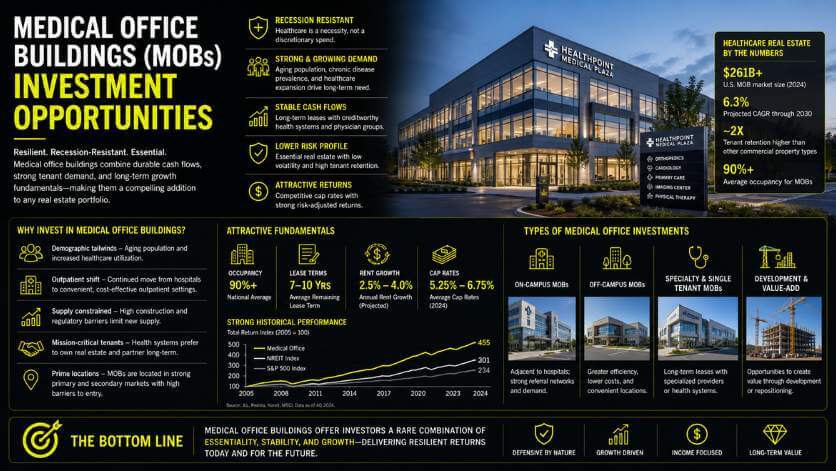
The demand for health care services continues to rise as the population ages, supported by new discoveries and medical advances that ensure more medical issues are addressed. There’s also a shift from reactive medical care to preventative care and wellness, reshaping the real estate footprint of the health care system. Instead of relying only on hospitals and inpatient care, there is growing reliance on medical office buildings and outpatient buildings. To put scale into perspective, there are about 7,273 hospitals in the United States, covering 1.9 billion square feet, alongside 42,260 MOBs totaling 1.6 billion square feet. These spaces support diverse tenant types and services like urgent care, emergency services, dialysis, ambulatory surgery, imaging, and physician offices. The MOB sector continues to increase in demand due to advancements in health care technology, shifting care to the outpatient setting, while inpatient and hospital space is reserved for advanced, complicated cases.With a national average price per square foot around $296 in the first half of 2023, and occupancy rates between 91.5% and 92.5% over the past decade, demand strong indicators continue to support long-term value. Success, however, depends on stable tenants, long-term leases, and overall resilience. Given rising competition, simply owning is not enough—maximizing returns requires strategic execution, carefully selecting properties, optimizing lease structures, and capitalizing on market trends. These key strategies, when applied consistently, can deliver the best possible returns.
WHAT IS A MEDICAL OFFICE SPACE?
Understanding Medical Office Space in Today’s Market
medical office space is quite different from traditional offices because these properties are uniquely designed and often subdivided to accommodate specific health care uses. Historically, many were built near hospital campuses, shaped by referral patterns where physicians worked closely with affiliated hospitals to serve patients seeking convenient care close to home. Today, this model is still prevalent not only in cities but also in suburban areas and rural areas, where medical office buildings can range from small, standalone facilities of around 1,000 square feet to high-rise setups in urban areas. From what I’ve observed, this demand continues to rise, giving investors strong opportunities to earn steady rent while improving access to care, which is becoming increasingly important.
When it comes to ownership, there are multiple forms—from individual owners who buy MOB buildings, to physicians who elect to own the real estate where they operate their practice or facility, and even national buyers like real estate investment trusts building large portfolios for diversification. Key elements such as price, cap rate, proximity to a campus, overall size, occupancy, and the credit worthiness of tenants—along with guarantees, lease structure, lease term, and annual escalations—all play important factors in evaluating these purpose-built assets. These spaces are tailored for healthcare providers, with specialized infrastructure for medical use, making them more attractive for investing than many traditional office spaces. They are fully equipped with exam rooms, waiting areas, and advanced HVAC systems that support medical professionals and patients needs, including soundproofing, privacy, and confidentiality required in a healthcare setting. Built for long-term medical use, they are strategically located near hospitals, nursing homes, and healthcare hubs, either on-campus to support referral networks or off-campus to serve suburban and rural communities. These properties are often leased or sold to physicians, dentists, and outpatient specialists, offering strong opportunities in real estate investing.
Many healthcare tenants, especially outpatient care providers, ensure consistent demand, which is why real estate investors value them. While some doctors still own properties, many now prefer to lease or sell and focus fully on patient care, creating substantial investment opportunities for real estate groups seeking stable, long-term tenants in specialized real estate assets tied to the medical field. These healthcare practices differ from other uses because they include specialized building systems that support medical activities, such as heating, ventilation, and air conditioning (HVAC) systems that ensure proper air quality, minimize the spread of contaminants, and are carefully installed and maintain over time. They are commonly located in medical centers, often classified as facilities situated close to large hospitals with strong affiliations, though some are found further away where they remain essential for providers like dentists, doctors, and clinicians. Internally, these spaces are configured with exam room areas and waiting rooms, and the tenant mix is largely made up of related healthcare professionals who operate in coordinated environments and often entrust property management to experienced teams.
Types of Medical Offices
In healthcare investments, building a strong real estate portfolio starts with what is essential—to understand the different types of medical office buildings (MOBs). These are generally grouped into three main types, each with distinct characteristics, such as on-campus clinics tied to hospitals, off-campus outpatient centers serving local communities, and smaller standalone practices designed for specific specialties.
BENEFITS OF INVESTING IN MEDICAL OFFICE SPACES
There are many reasons why real estate investors are adding medical office buildings to their portfolios, and from what I’ve seen, the shift is very practical. One of the primary benefits of investing in this medical office category is how stable these product types tend to be, especially when compared to traditional sectors that fluctuate more with the economy.
THE STRENGTH OF THE HEALTHCARE INDUSTRY
The health care sector is one of the fastest-growing industries in the nation, and the growing demands for health care services continue to increase the need for health care workers. This makes the sector highly resilient, with prolonged demand supporting medical office buildings. In my experience, a medical office is a great option for risk-averse investors because the industry has strong underlying fundamentals. Even though medical offices are often seen as a niche product type, time has proves they are less risky compared to other niche real estate investment alternatives, something the investment community has started to realize—even if a bit late.
THE MOB INDUSTRY IS NOT RELIANT ON NEW DEVELOPMENT
Many prospective real estate investors have seen their peers suffer devastating losses during the 2008 financial crisis, largely due to the breadth of new commercial real estate development and the sudden market collapse. At that time, many investors were left with half-complete or underwater projects, highlighting the ebbs and flows of the real estate cycle and the deep uncertainty that can follow events like the COVID-19 pandemic. This has been a real surprise for many investors, making them more wary of investing in ground-up development projects.
CAP RATE AND YIELD ARBITRAGE
Compared to other product types, it’s not uncommon to see a favorable cap rate differential in medical office buildings, sometimes reaching 200+ basis points over retail or office property that is leased to a credit tenant or national brand. While these may seem safer from a risk perspective, their corresponding returns are often lower. When investors really peel back each layer of MOB properties, they often find them to be relatively low-risk. One of the biggest reasons to invest in medical offices is how well they are well-positioned to capitalize on cap rate and yield arbitrage, offering a smart balance between stability and return.
FIVE THINGS TO KNOW WHEN INVESTING IN MEDICAL OFFICE SPACE
When investing, a medical office building decision is never simple. It requires real understanding of the nuances in this sector. Most investors must carefully consider five critical aspects of the medical office industry, because in a first MOB investment, these are among the top things that shape long-term success and stability.
LOCATION IS A DRIVER OF MOB SUCCESS
In real estate, the oldest adage—location, location, location—is not just a saying; it is a real factor in reducing risk. For a medical office building, a critical location often decides its long-term success, especially when patient access and visibility matter.
Location matters in a few contexts
A key distinction is between on-campus and off-campus MOB properties. Those located adjacent to a hospital campus or under a formal affiliation benefit from strong hospital referral network activity, which can directly drive revenue and long-term success, sometimes even supporting higher health insurance reimbursements for certain treatments.
On the other hand, off-campus facilities attract growing interest from institutional investors due to rising demand for ambulatory care facilities and easier convenient patient access. As the U.S. population ages, care is increasingly needed closer to home, making these locations highly valuable. Rent potential in suburban and rural areas often depends heavily on local demographics, while densely populated areas usually outperform peers in alternative MOB investments. In Sunbelt states like Arizona, North Carolina, and Florida, strong population growth, rising retirees, and expanding health care needs make regional location analysis essential. Investors often evaluate aging population trends, especially where healthcare demand is increasing. Additional factors include whether the site is in a highly trafficked area, with strong visibility, road access, signage quality, vehicular access, and sufficient parking.
CONSIDER THE TENANT PROFILE
A strong tenant profile can define the success of any MOB opportunity. This may include a physician group, imaging center, or other providers with solid credit profiles and established history in the local market. A good tenant reduces risk and increases long-term stability.
QUESTIONS ABOUT THE SIZE OF THE BUILDING
The size of a building strongly influences investors when investing in medical office buildings, especially in multi-tenant setups. These are often preferred by public investors, real estate investment trusts, private companies, and family offices because they balance income with intensive management requirements.
SHOULD I GET AN UPDATED MEDICAL BUILDING?
Property obsolescence is a real concern in commercial real estate, especially in MOB investment within the fast-changing healthcare industry. As tenants and specialties evolve, older spaces must keep pace with modern requirements. Today’s competitive medical spaces are optimized for both patient needs and provider needs, something older buildings often fail to achieve.
The Strength and Adaptability of Medical Office Structures
One key reason medical office buildings remain successful is their ability to adapt as technology changes quickly. Modern healthcare spaces are designed to evolve with practitioners and shifting patient expectations, ensuring long-term relevance.
Today’s structures are built with flexibility in mind, using universal exam rooms, adjustable procedure room sizes, and layouts that can accommodate different purposes. Many now use modular design, traditional planning, or even prefabricated construction with replicable layouts that can scale across different facilities. This adaptability supports growth and allows buildings to evolve with healthcare demand. Increasingly, designs also incorporate technologies that support providers in serving patients virtually, expanding access beyond physical space.
THE ADAPTABILITY OF MEDICAL OFFICE BUILDINGS
In many cases, the perception around medical office buildings is that they are highly specialized and unique, but in reality they are far more adaptable than most people assume, with only a few exceptions like high-rise or strict on-campus MOBs. These spaces are often designed so tenant spaces can be repurpose easily across different healthcare specialties and clinical spaces that remain standard for most providers. Unlike traditional office space, which is difficult to convert, MOBs can go through real modifications such as capping, plumbing, and electrical service inputs to be adapted into functional medical units. I’ve personally seen former offices turned into medical exam room setups simply by being cleared out and redesigned, which shows how strong this adaptability really is.
THE NEED FOR MEDICAL OFFICE SPACE
Several factors are driving demand in investing in medical office buildings, but the core need comes from structural changes in healthcare and population growth. The demand is not temporary—it is built into long-term social and economic trends that keep expanding healthcare usage year after year.
An Aging Population
An aging population is one of the strongest drivers, with nearly 10,000 Baby Boomers turning 65 every day. A person in their 20s may visit a doctor once or twice a year, but the average person aged 65 and above may require care eight times a year. As this Baby Boomer generation ages, the burden on health care increases significantly, while national systems remain constrained, making healthcare infrastructure under constant pressure.
More Medical Specialties
Advances in healthcare research and technology have created more specialized medical care, leading to the rise of new medical groups and specialty physician practices. These up-and-coming healthcare providers directly increase demand for medical office space, as each specialty requires properly designed clinical environments to operate effectively.
Growth of “MedTail”
Another major trend is the growth of MedTail, where demand comes from a combination of medical office and retail space. These MedTail tenants often include both traditional medical providers and retail-based healthcare services like MedSpas, creating diversified revenue streams. For example, dental offices, primary care doctors, and other medical users now often co-locate with retailers in mixed-use development projects, giving patients more convenient care closer to home in non-traditional retail settings. This has become a viable alternative to standalone suburban medical office properties, improving both patient access and clinic visibility.
The Smart Investment Decision: Buying a Medical Office Building
Unlike restaurants that may struggle within a single year, or retail stores impacted by declining e-commerce sales, healthcare remains essential as Americans population ages. Because of this, many commercial investors now see purchasing medical office buildings as a more safe and lucrative investment option. From a long-term perspective, it is often considered one of the wisest investment choices in real estate today.
Why is Investing in a Medical Office Building the Smart Choice?
medical properties offer steady cash flow for investors because they are supported by longer-term leases with commercial tenants, which makes medical office buildings more stable than many other commercial properties. Even with the complicated nature of healthcare operations, relocation proximity hospital advantage medical practice location refer patients creates a strong retention effect. Private practitioners medical needs unique real estate asset class drivers relatively low-risk investment real estate product types burgeoning industry sector impenetrable barriers to entry available investors large and small growing number invest small standalone MOB properties institutional-quality variety appealing risk tolerances geographies all combine to make this sector flexible for different investor profiles. From my experience, even investors who prefer hands-on management invest alongside adept MOB sponsor passively passive income pursue approach day-to-day managed effectively can still benefit from this structure without being deeply involved.
INVESTING IN RECESSION-PROOF REAL ESTATE
The primary appeal for investors in medical offices is that this sector is highly recession-resilient compared to industries like retail, hospitality, and traditional office. Medical office buildings provide access to a critical need—health care, which is a non-discretionary industry. During an economic recession, people may postpone buying clothes or getting a haircut, and even with work from home reducing the need for office space, healthcare remains different because when someone is sick, they still need a doctor. Even if Americans try to rein spending or face uncertainty in the stock market, those who are insured may still postpone medical treatment, but demand does not disappear. From an investor view, this helps predict future economy demand, especially since real estate is often financed debt 20-year amortization schedule real estate cycles ten years. Statistically, a MOB investor purchases property cycles amortization period consider fare economic fluctuations steadfastness industry decades bright past 20 years health care practices demand increase confident endure economic ebbs flows foreseeable future, making it one of the most stable long-term real estate plays I have seen.
Tips to Maximize Returns on MOBs
Investing in medical office buildings offers stable income streams and long-term appreciation, but success comes from combining stability with innovation.
Choose Prime Locations
In real estate, location MOBs exception strong demographics population growth aging communities healthcare demand well-placed healthcare markets long-term occupancy referral networks investment opportunities demographic analysis high population growth regions aging population specialists chronic care family density pediatricians family medicine diverse mix healthcare providers built-in referral network patient volume occupancy all determine long-term success.
Leverage Smart Financing To Optimize Your Investment
MOB investors financing options SBA loans CMBS financing traditional bank loans partnering lenders experienced medical office building real estate loan terms market insights conventional bank loans competitive rates strong credit financials Small Business Administration loans lower down payments extended repayment terms owner-operators Commercial mortgage-backed Securities access capital acquisitions specialize healthcare real estate smart financing higher return on investment ROI helps investors scale efficiently while managing risk.
Boost Returns With Proactive Medical Office Property Management
Strong tenant relationships responsive maintenance competitive MOB lease terms high-credit healthcare providers relocate efficient management consistent returns strategies vet tenants background checks financial stability foster relationships connections providers satisfied operations lease terms long-term agreements escalation clauses responsive maintenance issues tenant retention property condition steady income minimize vacancies directly improves asset performance.
Increase Property Value With Strategic Upgrades
property value strategic upgrades capital improvements upgraded HVAC systems modernized waiting areas telehealth-ready spaces competitive energy-efficient upgrades reduce costs sustainability-focused tenants functionality appeal upgrading HVAC plumbing electrical systems healthcare standards modernizing common areas lobbies patient waiting rooms break areas experience adapting healthcare trends converting traditional offices specialized spaces diagnostic centers telemedicine hubs energy-efficient systems operating costs eco-conscious tenants rental rates boost value shows how modernization directly increases valuation and rental income.
Minimize Risk With a Strategic Protection Plan
minimize risk strategic protection plan diversify tenant mix secure long-term leases compliance healthcare regulations risk management strategy durability investments savvy investors protect assets mitigation strategies avoid over-reliance single provider specialty financially stable tenants agreements zoning laws legal issues comprehensive insurance property damage liability claims natural disasters proactive approach safeguard consistent long-term returns ensures stability even in uncertain market cycles.



Leave a Reply