

Rethinking the Role of Malls in a Digital Age
The rise of e-commerce and changing consumer behaviors has deeply affected the traditional brick and mortar model. Many properties have struggled to remain viable, and large underperforming spaces now sit vacant. I have personally visited malls that were once the epicenter of the suburban lifestyle, full of energy and importance, but today they feel quiet. With huge growth in online shopping, consumers’ preferences have shifted drastically toward convenience, speed, and a broader product range. The traditional purpose of malls—to offer quick access clothing brands and a place to buy—is no longer enough.
Table of Contents
For years, malls were powerful symbols of consumerism, but now specialty retail bankruptcies, anchor department stores filing Chapter 11s, and brands that shuttered or filed bankruptcy have been destabilizing and upending shopping complexes. Analysts describe this period as the fall of the mall or even the retail apocalypse, common buzz phrases on consumer news sites. According to Placer.ai analysts in the Redefining the Mall white paper, the old one-size-fits-all mall style was often copied and pasted everywhere. There is now a clear realization that the classic anchor department store has limited reach. The pandemic and efforts to limit spread of COVID-19 only sped everything up—mall traffic plummeted, and many questioned the necessity of malls to survive in their old form.
However, instead of seeing this as the final nail in the coffin, many innovative developers, REITs, and planners are leading the charge to reimagine these massive assets. They see enormous square footage, tons of parking, and appealing locations near population centers, public transportation, and major transportation routes as a unique opportunity. Rather than demolishing and rebuilding, they focus on adaptive reuse, a creative solution and sustainable solution that helps breathe new life into former retail properties. This widespread trend is reshaping retail properties, driving economic revitalization, and delivering substantial social benefits. It also means saving costs, reducing environmental waste, and reducing carbon output compared to building new structures.
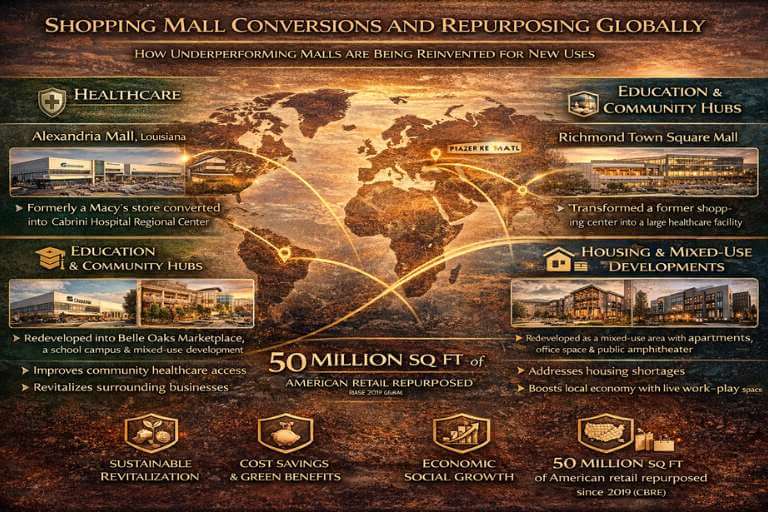
Some of the most impressive global examples show how underperforming malls and big-box stores can address critical societal needs. In Alexandria Mall, Louisiana, a former Macy’s store became a regional medical center through an adaptive reuse project that now offers essential healthcare services. This project not only revitalizes the mall and is driving foot traffic, but also supports surrounding businesses. Similarly, Vanderbilt University Medical Center, Tennessee converted a former shopping center into a comprehensive healthcare facility, meeting community health needs and reducing strain on nearby hospitals. These sites provide ample parking, strong proximity to neighborhoods, and large flexible interiors, giving healthcare providers clear strategic benefits.
Education is another powerful direction. In Cleveland, Ohio, the Richmond Town Square Mall was redeveloped into Belle Oaks Marketplace, now a school campus with residential spaces and commercial spaces under a multi-use approach. This created a vibrant, community-focused environment. Likewise, the former Sears store, Memphis, Tennessee was transformed into Crosstown Concourse, a mixed-use facility with a high school, office spaces, and arts-focused organizations, becoming a hub for education, creativity, and the local community. These projects show how educational institutions and training centers are leveraging accessibility and scale to accommodate students and staff, redefining malls as community assets and education hubs rather than simple shopping centers.
Housing is another response in cities grappling with housing shortages. Through retail-to-residential conversions, empty malls become a lifeline. In Austin, Texas, the Dead Mall Apartments project turned a defunct shopping mall into affordable housing units, helping meet the city’s growing housing demand. Developers are integrating green spaces, communal areas, and other initiatives to attract new residents to formerly declining neighborhoods. In Arlington, Virginia, new high-rise apartment complexes by Witmer and Milton have sprouted up, housing 700 individuals within walking distance of services. These models show how spacious layouts of department stores can support high-density housing, ending housing squeezes, reducing blight, and even transforming a parking lot or empty atrium of a failed mall into playgrounds, gardens, parks, and flats.
Across the country and globally, developers such as Kimco Realty are exploring apartment rentals as a lucrative venture, promoting a live-work-play environment. In Phoenix, the Paradise Valley Mall redevelopment includes a public amphitheatre, preserving the existing structure while promoting walkable urbanism in the suburbs and generating foot traffic for remaining retailers. Reports on Stantec.com and by CBRE note that nearly 50 million sq ft of American retail has gone from the market, yet the trend picks up speed as more mall conversions become popular ideas. According to Smart Cities Dive, and researchers like Devi and Franklin, 2025 and Kiger, 2023, more than half of mall-reuse plans are aiming simultaneously at healthcare, education, and housing, showing that the traditional concept is truly fading away.
From my experience in studying commercial real estate market shifts, I see that these creative conversions are not random. They are part of an emerging trend where planners and builders are envisioning high-density mini-cities inside abandoned malls. Instead of concrete, fortress-like temples of consumption dying on the vine as shoppers bypass them and head to the Internet, they are being transformed into communities that support city life within their existing footprints. By repurposing existing structures, cities can save construction costs, create jobs, stimulate local economies, and enhance property values in surrounding areas. In this way, malls are no longer just about marketing strategies or fighting declining retail demand; they are becoming resilient, sustainable spaces designed to meet modern challenges and offer a brighter future for communities nationwide.
Creative Ways Malls Are Repurposing Their Space
In recent years, many malls and large department stores have faced serious pressure due to the pandemic, declining foot traffic, over expansion, and the collapse of major anchors. Several once-busy shopping center locations have simply fallen away, leaving behind empty real estate and vast centralized spaces that created a real logistical conundrum for owners. Instead of giving up, developers began exploring creative ways of repurposing unused space through bold revamping strategies. After waves of bankruptcies, these massive properties were no longer seen as failures but as existing assets with unlimited potential.
One of the most practical shifts has been turning retail centers into health-focused hubs. During the health crisis, many malls were used as vaccination spots and temporary clinics, proving they were plausible spaces for long-term healthcare use. Today, healthcare providers are moving in permanently, offering primary care, specialty care, and even oncology services inside former stores. Some have transformed an entire mall into a medical campus, using thousands of square feet and even surrounding acres of mall property. In certain cases, former anchor tenants have been replaced by hospital systems’ global headquarters or administrative offices, creating a new concept of healthcare-driven campuses. Because mall real estate sits in centralized locations, it offers strong cost advantages, especially in today’s distressed real estate market within commercial real estate. The efficiencies of costs, large parking areas, and ability to centralize multiple services make these properties a smart solution, as one executive director of business and finance recently described them—true “blank canvas” opportunities.
COVID Vaccination Sites and Medical Spaces
The last decade has not been kind to many department stores. The pandemic only sped up problems that were already visible—declining foot traffic, over expansion, and struggling anchors in every major shopping center. Big names like Sears, Lord & Taylor, J.C. Penney, and Neiman Marcus faced bankruptcies, and by spring 2020, reports from Green Street Advisors predicted that nearly half of mall-based department stores could close by the end of 2021. Across the United States, this created massive amounts of empty real estate and large centralized spaces that became a serious logistical conundrum for owners. Yet, these same spaces proved perfect for COVID-19 vaccinations, turning former retail giants into vital vaccination spots for locals.
Gamer Headquarters
Not all mall transformations are about healthcare. Some are about ambition on a global scale. In 2024, Epic Games, the operator of the blockbuster game Fortnite, began converting the entire mall at Cary Towne Center, Cary, North Carolina, into a massive corporate campus. The company had been located in the area for over two decades and was moving from its current headquarters just a few miles away. For a fast-growing video game company, the site offered ample space—about 980,000 square feet spread across 87 acres of mall property, enough for modern offices and open community space.
Churches
Another surprising trend is churches flipping retail property for another use. This is not entirely new; the new concept dates back to the late ’90s, when congregations began moving into former retail sites. Lakes Church, formerly known as Church at the Mall before its late 2019 name change, in Lakeland, Florida, even purchased an entire mall. Other churches have taken over spaces once occupied by Sam’s Club or Montgomery Ward, turning old shopping center layouts into spiritual campuses for a growing congregation.
Office Space
Many experts argue that shopping centers are inherently similar to office real estate because of their open square footage, wide corridors, and generous parking. This makes them well positioned within the office sector, especially for businesses wanting to stay close to the community and centralize operations. In 2019, Google signed a lease for the former Westside Pavilion, Los Angeles, planning an office campus known as One Westside, which was fully converted by 2022. The site connects to the Los Angeles Metro Expo Line, offering direct light-rail service between downtown and Santa Monica.
Other brands are following similar paths. Hudson’s Bay announced plans to redevelop a former Lord & Taylor store at King of Prussia Mall into modern office space, according to the Philadelphia Business Journal in late January. In many projects, only a portion becomes offices, while other sections include co-working spaces. For landlords, this strategy helps support remaining stores and restaurants, creating steady daytime activity that can drive traffic back to the property.
Warehouses Globally
Even before the crisis, mall traffic had begun to taper off, and some transformed spaces into warehouses for retail fulfillment. The trend started prior to the pandemic, but rapid growth in e-commerce was intensified by COVID-19. Retailers needed to accommodate expanding online operations, and demand for logistics space grew nearly three times faster than for traditional storefronts, according to a 2020 report by Prologis. Empty stores became fulfillment locations in well-located logistics areas, offering faster service to customers.
Purpose of Shopping Malls and Their Marketing
For decades, shopping malls have served as a critical place for the community, offering multiple facilities in a single building. From clothing shops and restaurants to entertainment, these centers were designed to gain attention and provide convenience by grouping multiple shops so shoppers could accomplish everything in one trip. However, as economic patterns shifted and digital technologies advanced, the traditional roles of malls became outdated. Many malls struggled to evolve, but modern malls are now breathing new life into these spaces by adopting updated trends, including experiential environments, hosting live events, art installations, and additional services like fitness centers and spas to extend customer visits.
In the community, malls act as anchors, hosting cultural events, medical services, and experiential engagement that attract visitors beyond shopping. Reports from AeroHub highlight that malls that integrate these offerings are better at attracting and retaining foot traffic, reinforcing their role in society even as digital convenience dominates. Marketing strategies have also shifted; trendy malls now focus on experiential engagement, using advertising products, destinations, curated events, pop-up installations, and influencer partnerships to gain customers. Through targeted social media campaigns, malls create social-media-worthy moments that turn shopping into retailtainment, blending a mix of retail and entertainment to inspire impulse purchases.
Rise of Online Shopping and Its Impact on Shopping Malls
The explosive growth of online shopping has disrupted traditional retail models and reshaped the expectations of consumers. Studies at the Digital Commons at Buffalo State show that global e-commerce sales reached $5.7 trillion in 2022, with platforms like Amazon, Alibaba, and Shopify offering millions of products at competitive prices. The comfort of their homes, combined with one-click ordering, same-day delivery, and personalized recommendations, has raised the expectation of convenience. Meanwhile, real stores struggle to keep pace. According to Green Street Advisors, 2023, mall traffic in the United States has declined nearly 30% since 2017, leading to closure of well-known stores like Sears and JCPenney, which were once key tenants that drove mall visits.
Why People Prefer Online Shopping
Popular opinion and surveys reveal that major advantages of online shopping have shifted consumer habits far from traditional malls. The convenience of being able to browse, compare, and purchase products any time without leaving homes is a crucial role driving adoption. Shopping online is less time-consuming, financially beneficial, and eliminates transportation and physical effort, offering a streamlined, efficient experience via any device with an internet connection. A survey by Jungle Scout, 2023, found that 77% of U.S. consumers cited financial incentives, like exclusive discounts, flash sales, and free shipping, as the primary reason for preferring digital over physical shopping.
The depth of products online is also unmatched. Platforms like Amazon, eBay, and Etsy offer millions of items, from everyday essentials to niche products, with richer product information, customer reviews, and price comparison tools that empower buyers to make clearer decisions. During the COVID-19 pandemic, online channels became a critical lifeline to obtain goods, proving their resilience and adaptability. Statista reported that global e-commerce sales rose 27.6% in 2020, highlighting the increasing reliance on digital platforms.
Retail Projects Repurposed
Across the globe, retail projects are being repurposed to revitalise landmark buildings and regenerate marginalised retail space. Mall owners are now converting malls into mixed-use schemes, incorporating office, hotel, apartments, transport hubs, and social services, transforming them into all-of-life lifestyle destinations. These redevelopment efforts enhance shopping centres while creating joint ventures between developers and local government, often rebuilding large shopping malls into new town centres that function as long-term strategic urban renewal development sites.
Many projects integrate city hall, office and retail space, apartments, medical centres, education facilities, and light-rail stations, turning previously dead retail space into a catalyst for growth for the local workforce. Repurposing dead retail space into hospital campuses or university campuses has become a large-scale strategic mixed-use approach that offers future insight for developers. By retrofitting and redeveloping, these spaces create a vibrant community hub while rewriting the rule book for developing town centres in the second decade of urban growth.
United Kingdom
In the United Kingdom, several retail projects are being revitalised to regenerate marginalised retail space and breathe new life into landmark buildings. A prime example is the Grade II listed Co-op department store in Sheffield, once the centre of the city’s retail offer but falling into decline. Spanning 80,000 sq ft (7,430 sq m), the store closed its doors in 2008, leaving a dilapidated, iconic building at the heart of the city. A decade later, a £3m funding deal between the city council and regeneration company U+I helped restore the building, reflecting the developer’s ethos of using historic sites as a catalyst for regeneration in the wider locality.
Australia
In Australia, mall owners like Vicinity and Scentre Group are repositioning malls into mixed-use schemes, combining shopping with office, hotel, apartments, transport hubs, social services, childcare, senior care, medical, and tertiary education facilities to create all-of-life lifestyle destinations. A major redevelopment project at Melbourne’s Westfield Doncaster saw an investment of A$500m, adding 43,000 sq m of retail, 18,000 sq m of office space, and health and wellness offerings. Similarly, a joint venture at The Glen, Melbourne added 13,500 sq m of mall space, enhanced leisure offerings, 500 homes, offices, and a 4,000 sq m rooftop public realm project called Garden in the Sky, blending living, working, dining, and shopping experiences.
United States
The United States has been leading the way in repurposing dead retail space through large-scale strategic mixed-use sites. In Denver, Colorado, the failed Cinderella Mall in the suburb CityCenter Englewood underwent a long-term strategic urban renewal development that integrated city hall, 44,600 sq m of office and retail space, 440 apartments, medical centres, education facilities, and a light-rail station. This transformation created a new downtown area, acting as a catalyst for growth while providing jobs and services for more than 25,000 people, proving the potential of retrofit and redevelopment in urban centers.
Conclusion
The transformation of shopping malls from single-use retail hubs into mixed-use, community-focused spaces reflects a major shift in how cities, developers, and society view these vast properties. Once symbols of consumerism struggling with declining foot traffic, bankruptcies, and shuttered anchor stores, malls are now being repurposed to meet modern challenges—offering residential units, office campuses, healthcare facilities, educational institutions, cultural venues, and entertainment hubs. By leveraging existing assets like large interiors, ample parking, and central locations, developers are creating vibrant districts that reanimate neighborhoods, drive foot traffic, and deliver substantial social and economic benefits, while also reducing environmental waste through adaptive reuse.
From a broader perspective, these repurposed malls serve as catalysts for urban resilience, sustainability, and community wellbeing. They bridge gaps in housing, healthcare, education, and recreation, turning once underperforming spaces into thriving centers of activity. Across the United States, United Kingdom, Australia, and beyond, these innovative projects showcase how creative planning, mixed-use strategies, and modern design concepts can redefine the role of retail properties. In doing so, they ensure malls not only survive the digital age and the rise of e-commerce but reclaim their place as essential, dynamic assets for people, cities, and the planet.


Leave a Reply