
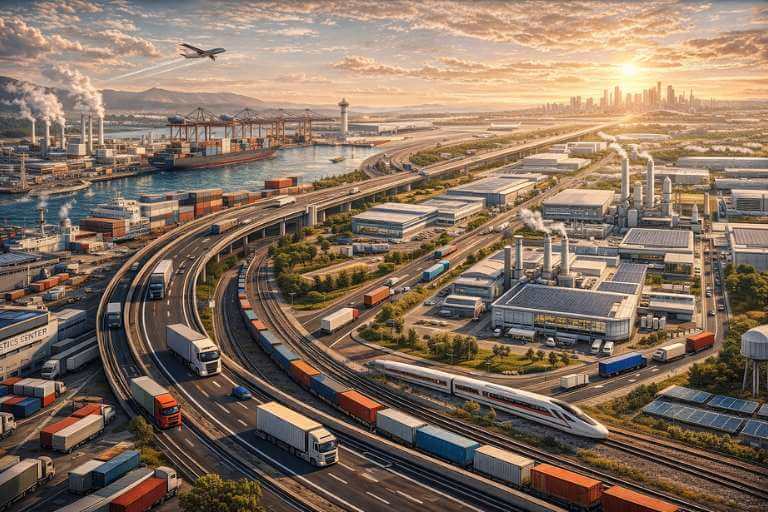

When we talk about industrial areas, many people imagine smoke and factories. But today, industrial parks, industrial estates, and other forms of planned development are much more organized and strategic. These are carefully outlined areas usually placed near the city edges, not in the central residential area, to balance work and living spaces. Their success depends heavily on transportation access such as road, rail, ports, highways, airports, and strong railroads. This proximity to multiple transport modes allows large industrial areas to perform important global functions, supporting industrial facilities and large-scale business activity. From my observation while studying development models, this structure is no accident; it reflects deep modernization efforts across different industries supported by serious infrastructure growth and strong transportation infrastructure planning.
Table of Contents
In many developing regions, progress is not easy. Countries often face limited resources and scarce implementation capacity, along with a weak business environment. To respond, governments create enabling infrastructure within a special territory under a clear government establishment framework. The goal is to build a conducive environment that can attract investment and increase investment flows despite critical constraints. In practice, I have seen how such zones act as a strong industrial policy instrument that supports growth and development when national systems are still evolving.
Around the world, these zones appear under many terminologies such as free-trade zones, FTZs, export processing zones, EPZs, special economic zones, SEZs, high-tech zones, free ports, and enterprise zones. While their objectives, functions, forms, and differentiation may vary, they all support structured industrial programmes often guided by institutions like UNIDO. These are known as location-specific instruments, designed to serve national priorities. Newer models include eco-industrial parks, sustainable industrial parks, agro-food parks, and techno parks, each offering a dedicated location for firms settlement and stronger employment creation. They help in export boost and accelerate industrialization processes by improving access to infrastructure, technology, and finance, while reducing production costs and transaction costs, especially in countries struggling with weak institutions.
The strength of these business locations often lies in agglomeration and clustering. In simple terms, when companies work close to each other, they benefit from sharing, synergy, and collaboration. In my research reading, experts often mention five characteristics of successful parks: clear governance, quality services, market access, innovation support, and environmental care. Modern parks focus strongly on sustainability and the circular economy, which reduce waste and protect resources. Organizations like the World Bank, Deutsche Gesellschaft für Internationale Zusammenarbeit, GIZ, and the United Nations Industrial Development Organization support such initiatives across different continents, aligning them with Goal 9 of the 2030 Agenda, which promotes resilient infrastructure, inclusive industrialization, and aims to foster innovation.
In the Middle East, especially in several Middle Eastern countries, there has been clear dedication since the 1970s to using industrial zones as a critical role player in national transformation. Academic literature, including Scinotometric analysis and studies using panel data with selected variables, has examined industrial park performance between 2000 to 2018. These studies link strong policy implementation to higher economic growth, better regional development, and even some reduction in disparities, although environmental issues remain a concern and an area for future research. Many zones have evolved into upgraded counterparts with new competitive advantages, especially across the Middle East.
A practical example of knowledge sharing happened on 7 May 2021, when enCity hosted a webinar on Integrated Industrial Townships. The event discussed challenges, innovation, planning, design, and implementation of this new development model. As someone who closely follows such discussions, I found it insightful that investors now look beyond low land value and focus more on smart production processes. The session included a strong panel of speakers such as CEO Mr. Dzung Do Nguyen, Mr. Huynh Quang Hai from VSIP JSC Group, who serves as Executive Director, Co-Chairman, and leader of VSIP North and Central, also linked with Vice Chairman roles at BW University and Industrial Park and Becamex IDC Corp. Other contributors included the President of VNTT Joint Stock Company, a JTC Board Member, Prof. Heng Chye Kiang, a Senior Advisor and experienced Singapore industrial park developer, and Mr. Pablo Acebillo, Senior Associate in Master Planning and design management. They shared insights on manufacturing industry trends, the integrated township model, and smart planning strategies to mitigate challenges during an open forum attended by 100 attendees from many global nations.
Iconic examples like Suzhou Industrial Park, China and Jebel Ali Free Zone, UAE show how megastructures can become strong production hubs supporting modern economies, global manufacturing, and global trade. Their advanced industrial park design strengthens competitiveness and resilience, shaping the next generation of industrial ecosystems where technology, logistics, and sustainability convergence work together. These models prove that with the right planning, industrial zones can drive long-term regional development while supporting national and global progress.
Rethinking Industrial Zones Through Eco-Industrial Park Models
Industrial corridors are now being redesigned to support social development and long-term economic benefits, and this is where the idea of an eco-industrial park becomes important. Unlike the traditional industrial park model, which mainly focused on commercial activities and rapid output, modern industrial parks are becoming more resource-efficient, risk resilient, and environmentally aware. In many investment regions, these parks act as strong hubs that connect infrastructure, service development, and industrial activities in a smarter way. From what I have observed in development discussions, the shift toward sustainable industrial development is not just about protecting nature; it is also about creating positive impacts for local communities while responding to global issues like climate change. These parks are often developed within special economic zones and other industrial zones, where thoughtful planning helps reduce negative impacts such as environmental degradation and resource depletion.
An EIP works by applying effective management practices so industries can share resources, reduce waste, and become more cost-effective and competitive at the same time. This approach supports inclusive industrial development, generates social benefits, and strengthens economic growth by helping companies maximize benefits from shared systems. In many countries that are transitioning toward greener economies, such parks help mitigate challenges like labor challenges while still promoting economic progress. Because they balance environmental benefits with business goals, they are increasingly attractive for investment and seen as a practical way to ensure that future industrial expansion supports both people and the planet.
The Global Shift Toward Mega Industrial Parks
The global shift toward mega industrial parks is changing how countries design and manage large-scale industry. In the past, many cities depended on smoky manufacturing districts, but today modern industrial parks are built with smart zones, smart infrastructure, and strong digital connectivity. Across Asia, the Middle East, and Africa, governments are investing in massive infrastructure development to create spaces where factories, R&D centers, and innovation clusters work together in full integration. A single industrial park can now combine large size and high output with clean energy, renewable power plants, and advanced intelligent management systems. This new model supports better industrial planning, improved connected logistics, and stronger energy efficiency, making these parks more prepared for 2025 and beyond.
In many emerging economies, this transformation is not only about expansion but also about sustainability, adaptability, and long-term economic strength. I have noticed that successful developers focus on balancing technology with environmental goals, ensuring that growth does not repeat the mistakes of the past. By building smart utilities and promoting efficient resource use, these mega parks show how thoughtful planning can turn industrial growth into a story of measurable success on a global scale.
What Defines a Successful Industrial Park?
A successful industrial zone always begins with a solid foundation built on strong industrial planning. The first key factors are location and access to ports, highways, and markets, along with workforce availability. In my experience studying park models, the site is the first foundation because the optimal use of land and capital decides long-term returns. Under a clear 2025 vision, planners now combine sustainability, automation, and digital intelligence to ensure industries grow with future needs in mind.
A well-planned industrial park also integrates infrastructure such as power, water, waste, and data management so that industries can operate seamlessly, responsibly, and in a coordinated way. Strategically placed parks near airports often act as magnets for foreign investment. With logistics-based layouts, circular road systems, and dedicated transport corridors, they help reduce bottlenecks and improve efficiency. Today, planners use digital mapping tools and AI simulations to visualize resources flow, making modern industrial planning more precise and productive through smart infrastructure, strong connectivity, higher efficiency, and better productivity.
Core Principles of Modern Industrial Planning
The heart of modern success lies in structured industrial planning that aligns infrastructure with economic goals. A successful industrial zone is not random; it ensures balanced location, strong access, and integration with global trade routes. With clear strategies, parks connect industries to ports, logistics networks, and skilled workers to meet global standards by 2025.
Equally important is technology-driven coordination. By using advanced tools, planners ensure every element—from utilities to transport—works together. This creates an environment where industries operate efficiently, minimize waste, and maximize output while staying competitive in global markets.
Balancing Industry and Environment
One of the biggest challenges in industrial park design is to balance industrial productivity with environmental stewardship. Today, developers include renewable energy systems like rooftop solar panels and district-level wind turbines directly into project blueprints. Many new eco-parks are emerging as interconnected systems where waste heat from one plant powers another, and recycled water supports landscaping and cooling systems.
For governments and investors, green infrastructure is no longer a luxury but a necessity. Meeting international environmental standards such as LEED and ISO 14001 attracts multinational tenants seeking sustainable operations. Platforms like ArchDaily highlight how integration of green corridors, shared logistics centers, and mixed-use zones within industrial estates has become a defining trend in industrial architecture worldwide, strengthening the link between the environment, sustainability, innovation, efficiency, and resilience.
What are eco-industrial parks (EIPS)?
Eco-industrial parks (EIPS) are part of the green economy and the circular economy, designed as a business park or community of companies sharing a common area to improve environmental performance, economic performance, and social performance. Through mutual collaboration and smart resource management, they share energy, water, by-products, and information, supported by shared infrastructures, local institutions, and local communities. Their goal is to reduce waste, pollution, and overall environmental impact through sustainable practices, renewable energy, and innovative technologies, supporting low-carbon industrial development.
Unlike traditional industrial parks, these models promote inclusive development and sustainable industrial development. Known also as circular economy business parks or green economy business parks, they come in different sizes and types, inspired by worldwide examples, some already operating and others under construction, all delivering measurable environmental benefits, economic benefits, and social benefits.
Progetto Manifattura, Italy
Progetto Manifattura is a leading technology park managed by Trentino Sviluppo in Rovereto, near Trento, developed within the former Manifattura Tabacchi, a historic tobacco factory from the Austro-Hungarian Empire. The site was transformed into renovated facilities offering suitable spaces and advanced tools supported by the Ministry of Enterprise and Made in Italy initiatives. Today, it serves as a development center for creativity, hosting organizations focused on the circular economy, intelligent building, sustainable mobility, and clean energy, while also supporting the sports industry and improving quality of life.
The park welcomes innovative startups, small and medium enterprises, and large industrial groups, working closely with universities like the Faculty of Motor Sciences, University of Trento, and University of Verona, as well as research centers such as CIMEC, COSBI, and CERISM. Projects like Be Factory highlight its role as a low carbon production complex, partly designed by architect Kengo Kuma, featuring high energy performance, high comfort, and low environmental impact through the use of wood, glass, transparent curtain walls, advanced optic fiber, and green roofs, positioning it as a model for Europe.
Environment Park, Italy
Located in Turin, Environment Park is a major technology hub for sustainable innovation and green technologies, created at the end of the 90s. Spanning 30,000 square meters, it hosts over 70 companies and advanced research labs within a campus known for eco-friendly architecture and green building solutions. The site includes green roofs, green walls, rainwater recovery, radiant ceiling systems, floor systems, photovoltaic solar panels, electric vehicle charging stations, rooftop beehives, and even a hydroelectric power plant.
Designed as a campus in harmony with territory, it offers catering services, common green areas, and active networking spaces. Through training, dissemination, events, workshops, and acceleration programs, it supports startups and established businesses, strengthening innovation-driven development and long-term sustainability.
Park 20|20, Netherlands
Park 20|20 in Hoofddorp, Haarlemmermeer, near Amsterdam and Schiphol Airport, benefits from a strategic location and excellent accessibility to major Dutch cities. It attracts international companies by offering a high-quality work environment based on the Cradle to Cradle model (C2C) and a strong circular approach to design, production, and daily operations. The park integrates workspaces, a hotel, restaurant, sports facilities, and childcare facilities, promoting true work-life balance.
Kalundborg Symbiosis, Danimarca
Established in 1972 in Kalundborg, Zealand, near Copenhagen, Kalundborg Symbiosis is one of the world’s first examples of industrial symbiosis and a functioning circular ecosystem. It connects 17 companies, both public and private, through structured resource exchange systems sharing steam, cooling water, waste materials, and other waste flows transformed into valuable resource flows benefiting both the environment and the economy.
Händelö Eco-Industrial Park, Svezia
Located in Norrköping, in eastern Sweden, Händelö Eco-Industrial Park is a strong example of how the bioeconomy can create real synergies between industries. The park connects energy companies and the processing industry, where by-products and waste products from one plant become valuable raw materials for another. This close cooperation also involves institutions, universities, and local communities, making the park a shared regional effort rather than just an industrial site.
Berrechid Ecoparc, Marocco
The Berrechid Industrial Ecopark, located in Sidi El Mekki, plays a growing role in the African industrial landscape. Certified with HQE Aménagement certification, the site covers 61 hectares and hosts around 192 companies. It offers flexible building land plots and ready-to-use buildings, supported by high-quality infrastructure at competitive costs, making it attractive for both local and international investors.
Cleantech Park, Singapore
CleanTech Park in the Jurong Innovation District is closely linked with Nanyang Technological University and represents Singapore’s vision of an advanced eco-business park. Developed by JTC Corporation, the park focuses heavily on research and development within the clean technology sector. Spanning 50 hectares, it has become a model of innovation-driven sustainability in Asia.
Šabac Greenfield Eco-Industrial Park, Serbia
The Šabac Greenfield Eco-Industrial Park is a newly conceived industrial park built on strong sustainability principles in the Western Balkans. Considered a pioneering initiative, it aims to promote sustainable industrial development in Šabac, one of the region’s largest industrial areas. The project covers nearly 600 hectares and is expected to be fully operational by 2028.
The World’s Largest Industrial Parks
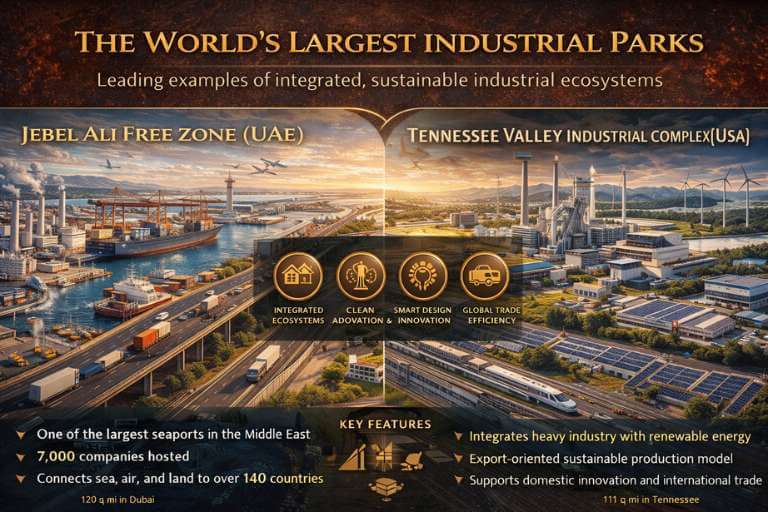
The world’s largest industrial parks are redefining how industry interacts with society by creating living ecosystems that combine industrial hubs with residential zones, commercial zones, and educational zones. These parks emphasize human-centered planning, where housing, lifestyle facilities, and production coexist in a single integrated ecosystem. Innovation and clean energy adoption are central, with technological leadership ensuring sustainable, future-ready operations. The best examples, such as Suzhou Industrial Park, China, and key developments in Singapore, show how successful examples blend integration, collaboration, and smart design into a coherent model.
Jebel Ali Free Zone (UAE)
Located in Dubai, the Jebel Ali Free Zone (JAFZA) has become one of the largest seaports and a major industrial hub in the Middle East. The park supports global trade efficiency, connecting sea, air, and land to more than 140 countries. Its infrastructure hosts 7,000 companies, including major manufacturing brands and logistics brands. The design philosophy emphasizes scalability, with modular warehouses and high-speed fiber networks, allowing businesses to expand or downsize without disrupting operations.
Tennessee Valley Industrial Complex (USA)
The Tennessee Valley Industrial Complex, located in the Atlantic region of the United States, demonstrates how traditional manufacturing expertise can merge with a modern energy strategy. The massive site integrates heavy industry with renewable power generation, creating a sustainable production model. By combining clean energy goals with an export-oriented approach, the park supports both domestic innovation and international trade, taking inspiration from Asian parks while emphasizing American workforce development.
The Evolution of Industrial Park Design
In the past, industrial parks were organized around basic function areas: production, storage, and administration were often separated by large distances, limiting efficiency and collaboration. Infrastructure focused mainly on foundations like high-capacity power lines, road access, and rail access, with minimal integration between operations. Today, next-generation industrial park design relies on AI, automation, and the Internet of Things (IoT) to create interconnected grids that self-regulate energy, water, and traffic flow. These smart grids allow planners and developers to optimize operations through digital tools, sensors, and central management platforms, making the parks efficient and sustainable.
Industrial Property Boom in Malaysia Might Cause Another Overhang Issue
In 2021, Malaysia recorded 300,000 property transactions, with industrial properties representing a low percentage of just 1.8%. While this might seem minor, it is telling of the economy’s structure: most developers focus on high-end condominiums, leaving industrial property markets relatively underdeveloped. Despite a thriving economy, pandemic-related disruptions, pay cuts, and job losses have created scenarios where overhang in residential and commercial properties might affect industrial growth if demand does not match supply over time.
How Do Industrial Parks Stay Competitive Amidst Ample Supply?
To remain competitive, industrial parks must evaluate their industrial park performance using a structured approach that identifies stakeholders, their roles, and the implementation process. By assessing incentives, capacities, and local context, park managers can design strategies that contribute to success at various stages, from park completion to operational growth. Performance analysis informs strategy adjustments to improve competitiveness, ensure economic spillover, and optimize investment attraction.
Conclusion
Industrial park developments around the world have evolved from simple, segregated industrial areas into integrated, people-oriented ecosystems that balance production, innovation, and community well-being. Modern parks incorporate smart infrastructure, clean energy, eco-industrial practices, and residential and commercial amenities, creating living ecosystems where workers, businesses, and investors thrive together. Successful parks rely on strategic planning, government support, and industry interlinkages to maximize economic growth, sustainability, and competitiveness. From mega-industrial hubs like Suzhou Industrial Park and Jebel Ali Free Zone to eco-industrial parks and integrated townships, the global trend emphasizes innovation, efficiency, and resilient industrial ecosystems that meet the demands of the next-generation economy.


Leave a Reply