
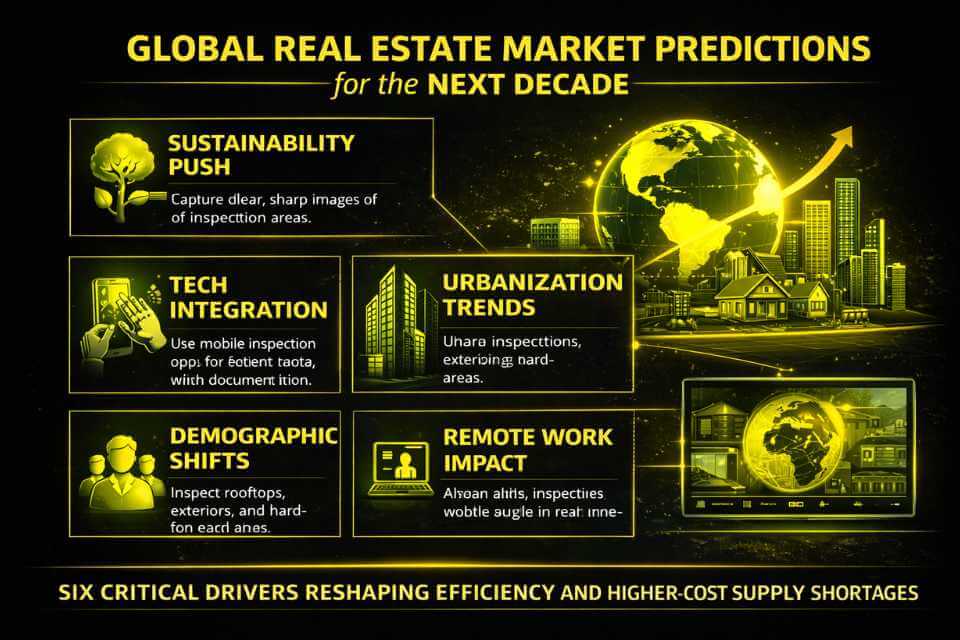

The 2026 outlook for the global real estate market appears positive, with improving fundamentals driven by economic growth across major markets. Recent data suggests easing trade concerns and moderating inflation are contributing to lower interest rates, creating a more stable operating environment. From my experience, investors who understand convergence of technological and social forces are better positioned to navigate this complex and evolving industry landscape. Commercial and residential property types alike are undergoing transformation, with six critical drivers reshaping efficiency and higher-cost supply shortages.
Table of Contents
Urban populations are influxing into cities, creating opportunities for developers to innovate compact, sustainable, technology-integrated, modern living spaces. Suburban and rural areas are also seeing mixed-use developments designed to optimize connectivity, infrastructure, and public services. Housing demand is influenced by consumer preferences, teleworking, and lifestyle shifts, while commercial real estate is driven by employment hubs, logistics, and large-scale modernization projects.AI implementation in buildings and property management is becoming a driver of long-term value.
From pilot programs to full-scale digital solutions, organizations are embracing data, analytics, and blockchain transferability to enhance control, insights, and efficiency. Smart-city concepts and integrated community planning are allowing developers and investors to strategize early acquisition and adaptive designs to support high-density ecosystems with sustainable infrastructure.Globally, residential, non-residential, industrial, logistics, and office sectors are all experiencing transformation.
The U.S., China, India, Western Europe, and Australia continue to lead in investment, while emerging markets such as Indonesia, Vietnam, and South Korea offer affordable and high-growth opportunities. Investors, buyers, and REALTOR®s need to navigate policy, regulations, and economic alignment to capture value from urban and metropolitan corridors.Technological adoption is also reshaping property services. AI-powered listing, IDX, VOW, computer vision, augmented and virtual reality, and data-driven analytics are enhancing market transparency, pricing, and rental projections.
From MLS Suite in the U.S. to Xiamen C&D in China, developers and investors are leveraging digital tools to optimize leasing, construction, and occupier satisfaction in high-demand locations.Economic growth projections by the International Monetary Fund suggest global GDP will rise 3.2% in 2023, supporting residential and commercial expansion. Government policies, infrastructure investment, and urban renewal programs are fostering long-term livability, connectivity, and sustainability. Developers and investors who strategize with flexible, technology-integrated designs can capture high-density, dynamic urban opportunities.
The next five years are expected to drive transformation across all real estate segments, from residential housing to logistics centers, industrial parks, and mixed-use developments. AI, smart-city concepts, and digital property management will continue to be critical drivers of efficiency, sustainability, and long-term value. Investors, developers, and policy-makers are presented with challenges and opportunities, and strategic, early acquisition combined with adaptive planning will be key to navigating the complex, evolving, and globally connected market.
Higher-cost environment will sharpen focus on efficiency
In 2026, organizations across sectors are facing an operating environment shaped by external cost pressures, including rising debt, borrowing, and government fiscal charges. Employers are managing higher labor expenses, payroll, and taxes, while grappling with skills mismatches, worker shortages, and elevated construction, materials, and fit-out costs. In regions like Europe, including the UK and Germany, inflation is predicted to rise in the range of 2.7-3% to 3.5-4%, while in the U.S. and Asia-Pacific, including Singapore and Australia, investors, developers, and occupiers are adapting to the confluence of factors driving cost management to the top of corporate real estate leaders’ priority lists.To respond, 72% of strategic real estate teams are rethinking approaches, budget lines, and space utilization to achieve operational efficiencies, cost reduction, and meticulous scrutiny of expense, asset optimization, and efficiency performance.
Proactive maintenance, capex planning, and contracts management allow portfolios to be right-sized, operations aligned with business needs, and a continuous drive toward partnerships, outsourcing, and supply chain optimization. Leveraging technology adoption in buildings, facilities, and service delivery creates a clear pathway to automation, digital solutions, and reduced operational costs without sacrificing service quality.The strategy requires careful calibration, with every initiative evaluated for its impact on employee productivity, resilience, user experience, and talent retention. Investors, developers, and corporate leaders are learning that optimizing space, operations, and buildings through technology and process improvements not only mitigates upward pressure from a higher-cost environment but also enhances long-term sustainability, efficiency, and performance across portfolios.
How is the Real Estate Market Responding to the Global Housing‐Affordability Squeeze and Rising Urban Demand?
As housing shortages and affordability pressures intensify across OECD and global markets, policy agendas are increasingly shaped by cross-country analysis showing the rise in price-to-income ratios and rent burdens for low-income households, with some countries reporting large share of owners and renters—up to 40% of disposable income—under squeeze. Demand for higher-density, mixed-use, and modular construction solutions is driving public-private delivery models, including inclusionary zoning, operators collaborating with cities, and supply-side acceleration paired with demand-side tools to preserve markets. Real-estate companies are piloting infill projects optimized for per-unit economics, working with local authorities for approval in quick times, focusing on quick wins to lower per-unit costs while increasing velocity of unit delivery to meet growing urban demand.
What are the Key Market Drivers, Breakthroughs, And Investment Opportunities That Will Shape the Real Estate Industry in the Next Decade?
The real estate market is undergoing a dynamic transformation driven by urbanization, evolving lifestyle preferences, and technological integration in property development and management. Cities with growing populations and economic employment hubs are seeing rising demand for both housing and commercial spaces, while mixed-use, modern, sustainability-focused, and convenience-oriented digital connectivity solutions are increasingly shaping consumer expectations.
Developers are adopting smart infrastructure, energy-efficient designs, and flexible living models, including green buildings and co-living arrangements, as they adapt and reuse existing structures to meet the needs of individuals, businesses, and urban environments.Interest rates, construction costs, and regulatory hurdles remain headwinds, affecting project timelines and profitability, but they also create opportunities for investors prioritizing ESG principles, smart-city partnerships, and resilient, community-driven developments. By embracing value-focused, evolutionary, adaptable, and technology-forward approaches, the built environment can better interact with the way people work, live, and engage in the coming decade, creating investment potential that aligns long-term urban growth with sustainable innovation.
How is the Rising Share of Urban Population Driving Real Estate Market Demand?
The rising urban population, according to the World Bank, is transforming the dynamics of the real estate market, as urbanisation and migration create increasing pressure on housing, commercial, infrastructure, and public services in cities that must adapt and grow sustainably. Developers are seizing this trend as an opportunity to invest in mixed-use, smart, transit-oriented developments that blend lifestyle, vertical, affordable, and flexible designs, while companies anticipate shifts in demand and plan for long-term advantages across land, emerging metropolitan corridors, using public-private partnerships to enable high-density, scalable, and livable projects in some of the fastest-growing areas of the world.
Global economic outlook
In the US, economic activity has been slowing, with elevated policy uncertainty and signs of decline in sentiment during Q1, while GDP nowcasts, models, and surveys suggest a large contraction but may be unreliable due to technical factors overstating the underlying slowdown. The labour market is cooling, increasing the probability of a recession in the near-term, while the Eurozone, particularly France and Germany, is seeing rollover growth prospects domestically with inflation pressures easing and fiscal measures in defence, infrastructure, and investment supporting medium-term expansion. China remains stronger, with GDP expected to grow 5.4% year-over-year, while monthly March and quarterly metrics show a robust property sector supported by authorities’ interventions. Japan’s Q4 growth was revised lower to 1.1%, with consumption, nominal and real wage growth deteriorated, and food costs accelerated in recent months, reflecting embedded deflation and easing pressures. For real estate investors and developers, these global economic trends signal both headwinds and opportunities, influencing property demand, pricing, and investment decisions across markets.
-
Will property prices continue to rise globally over the next decade?
Global real estate market predictions suggest mixed trends. Developed markets may see moderate 2-4% annual growth, while emerging markets could experience higher appreciation. Climate risks, demographics, and remote work will significantly influence regional price variations through 2036.
-
Which countries will have the best real estate investment opportunities by 2035?
Portugal, Spain, Vietnam, Poland, and UAE show strong potential. Affordable European markets, Asian growth economies, and Middle Eastern hubs offer diverse opportunities. Global real estate market predictions favor countries with stable governance, growing populations, and infrastructure development.
-
How will climate change affect property values in the next decade?
Coastal and flood-prone areas will likely see declining values, while climate-resilient inland locations gain premium. Global real estate market predictions indicate 10-20% value drops in high-risk zones. Green-certified buildings and sustainable developments will command higher prices.
-
Will remote work continue to impact real estate trends through 2035?
Yes, significantly. Suburban and rural properties will remain attractive as hybrid work persists. Global real estate market predictions show continued urban decentralization, increased demand for home offices, and growth in secondary cities offering lifestyle benefits with lower costs.
-
What role will technology play in future real estate markets?
AI-driven valuations, virtual tours, blockchain transactions, and smart homes will become standard. Global real estate market predictions indicate PropTech will streamline buying processes, reduce costs, and increase transparency. Digital currencies may facilitate international property purchases seamlessly.


Leave a Reply