


Comparing property prices Asia vs Europe vs America (across the world in 2026) raises a practical question for anyone planning to buy home or study abroad. Experts have analysed average wages, living costs, and house prices across Europe, North America, and Asia to reveal most affordable countries and least affordable countries. The difference in overall budget can be dramatic when considering housing, food, transportation, and healthcare, which vary widely across regions. International students especially must prepare for cost of living comparisons, as tuition and other expenses can quickly add up. Relying solely on averages can fail; real life costs depend on structure, housing format, healthcare access, and transportation habits, with systems organized differently in each country.
Table of Contents
Europe: High Costs with Some Budget-Friendly Options
Europe offers wide variations in living costs. Western Europe and Northern Europe, including the UK, France, and Sweden, remain expensive, while Central Europe and Eastern Europe like Germany, Poland, and Czechia are more budget-friendly. Monthly housing costs range from €400–€900/month, food from €200–€350/month, and transport from €40–€70/month, with student passes available. Healthcare is generally free or heavily subsidized for students, making Germany and smaller cities in Poland or Hungary the cheapest options. The UK, Switzerland, and Scandinavia are among the most expensive, showing softening property prices in some major cities but slowing demand due to tighter credit conditions.
Asia: Cost-Effective Alternatives
Asia offers a range of study destinations that are generally cost-effective. Countries like India, Malaysia, and Vietnam are very budget-friendly, while Singapore, Japan, and South Korea are pricier but still cheaper than North America or Western Europe. Housing typically costs $200–$800 per month, and food ranges from $100–$300, with street food and local markets helping to lower grocery expenses.
Transportation is affordable, usually $20–$60 per month with student passes, and healthcare is often subsidized, especially in Singapore and Japan. Overall, India, Vietnam, and Malaysia are the cheapest options, while Singapore, Tokyo, and Seoul are the most expensive, making Asia a practical choice for students and those considering relocation.
Global Property Trends and Research Insights
A new study covering 28 countries in the second quarter revealed property prices rose fastest in five countries, including three in Europe and two in Asia. Research suggested Hong Kong as a top performer, where residential property prices surged 16.4pc by year end June, contrasting a sharp turnaround in 2014 with a drop 0.66pc. Global Property Guide highlighted strongest house price growth in key markets, while Europe, North America, and parts of Asia continue to experience a property boom. Home prices and rents rise faster in major cities, creating constant trade-offs for people getting on ladder in 2026.
Comparing Practical Living Costs
Everyday costs are crucial when comparing Europe, North America, and Asia. Housing, food, transportation, and healthcare can vary widely; cost of living depends on structure, systems organized, and transportation habits. International students or professionals must consider tuition, expense, and overall budget. Using visualization of 25 major global cities, it becomes clear that softening property prices in Europe or slowing demand in North America can affect sustainable planning. Meanwhile, Asia offers affordable living but new study results indicate home values are rising faster in key markets like Singapore and Tokyo.
Strategic Insights for 2026
Property prices, living costs, and home values in major cities across world highlight constant trade-offs between average wages and affordability. People preparing to buy home or study abroad must rely on real life costs depend and not just averages. Europe, North America, and Asia show clear differences in housing format, healthcare access, and transportation habits, making comparison a practical question. Visualization, study abroad expense, and overall budget planning reveal most affordable countries and least affordable countries, ensuring decisions in 2026 are informed, sustainable, and aligned with dreams of getting on ladder in the world’s key markets.
Miami Leads Global Home Price Growth Since 2015
Miami has topped list of global cities with a staggering 93.1% increase in real home prices, showing the strongest decade-long appreciation globally, while rent prices grew only 12.7%, reflecting a widening affordability gap; similar trends are seen in other North American cities, with Toronto home prices rose 48% and rents climbed modest 8.3%, Vancouver saw a 39.7% jump in property values compared to 21.9% rent growth, and these disparities underscore how ownership demand in North America is fueled by migration, investment, and limited supply, which has far outpaced the rental market fundamentals, while New York City remains an outlier with declines in both home prices and rent prices, at 4.9% and 7.7%, respectively, highlighting the challenges of balancing investment, ownership, and affordability even in key North American markets.
Europe’s Home and Rent Price Changes Vary
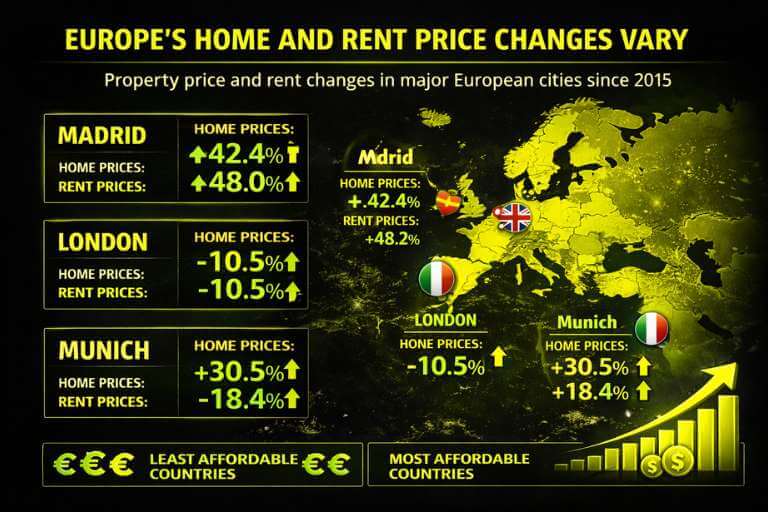
Europe shows housing performance that is highly varied, with property prices increasing in some cities while rent prices fluctuate, making getting on ladder in places like the UK harder for those hoping to buy home; experts have analysed property prices, average wages, and cost of living across the world to reveal most affordable countries and least affordable countries, and in major global cities, Madrid stands out as an outlier with significant increases where home prices rise 42.4% and rents surged 48%, the steepest rental increase, driven by Spain’s booming short-term rental sector and tourism rebound, in contrast, London has seen property prices and rent prices fallen 10.5% since 2015, reflecting Brexit and lingering effects, while Milan, another city, reports declines in both metrics, 4.9% and 3%, and Zurich and Munich experienced double-digit home price increases, 42.4% and 30.5%, with rent gains 23.1% and 18.4%, respectively, showing that housing, food, transportation, and healthcare vary widely, and anyone planning to study abroad or manage tuition and other expense must consider the difference in overall budget across Europe.
What Really Shapes the Cost of Living?
The cost of living in any city is influenced by multiple factors, including housing—whether rent, ownership, maintenance, utilities, or property taxes—and healthcare, such as insurance premiums, out-of-pocket costs, and access to private care. Daily expenses like food, groceries, dining out, and local price stability also play a key role, while transportation costs, including car dependency, fuel, and public transit availability, further shape overall budgets.
Lifestyle choices add another layer, with gyms, leisure activities, childcare, and personal services providing convenience but increasing expenses. Anyone planning to buy a home, study abroad, or relocate should consider how all these elements interact to form the complete picture of living costs in Europe, North America, or Asia.
USA: High Income, High Friction
in the United States, strong earning potential makes the USA attractive to high earners, retirees, and remote professionals, but living costs are increasingly uneven, with high housing costs in major cities, rising healthcare expenses, and insurance premiums adding to monthly overhead, while a car-dependent lifestyle further increases cost pressure, and persistent wide regional price gaps show that even those with good income face friction when planning where to live, buy home, or manage daily expenses, highlighting the tension between earning potential and real-world costs in USA.
Europe: Stability With Rising Baselines
In Europe, institutional stability and strong public services create a living environment that suits residents who value predictability and flexibility, where higher taxes often offset personal expenses for everyday services, making costs predictable though rarely cheap, and prioritizing reliable infrastructure, healthcare, and transportation allows people to plan overall budgets more effectively while navigating housing, food, and other living costs, highlighting that in Europe the trade-off between stability and affordability shapes how residents consider where to live, buy home, or manage daily expenses.
Asia: Lower Daily Costs, Different Trade-Offs
In Asia, lower day-to-day expenses for food and services make living feel affordable, but it requires significant adaptation to local culture, customs, and lifestyle, while navigating visa complexity and varying legal systems, meaning that anyone planning to study abroad, buy home, or manage daily expenses must weigh the benefits of lower costs against the challenges of adaptation and regulatory differences, highlighting that Asia offers real value but with unique trade-offs compared to Europe and North America.
Turkey: A Cost-Efficiency Bridge Between Regions
Turkey sits at the crossroads of Europe and Asia, and its unique geography and cost structure offers a rare balance, combining European-level infrastructure with Asian-level costs, which sets apart the country for those seeking lower housing and ownership costs, affordable private healthcare, modern facilities, and moderate utility pricing and service pricing, while less car dependency in major metropolitan areas and low annual property taxes compared to the West make living and buy home opportunities more accessible, demonstrating how Turkey can serve as a bridge for residents and investors looking for quality and cost-efficiency between continents.
Housing Formats That Control Living Costs
The cost of living is heavily influenced by how housing structured is chosen, and strategic choices such as managed residential complexes with predictable fees, low-maintenance apartments, and residences near daily infrastructure can make long-term living more affordable by reducing transport costs, while year-round homes help in eliminating seasonal price spikes, demonstrating that selecting the right housing format plays a key role in controlling living costs and shaping overall budget efficiency.
The 10 markets showing strongest house price growth
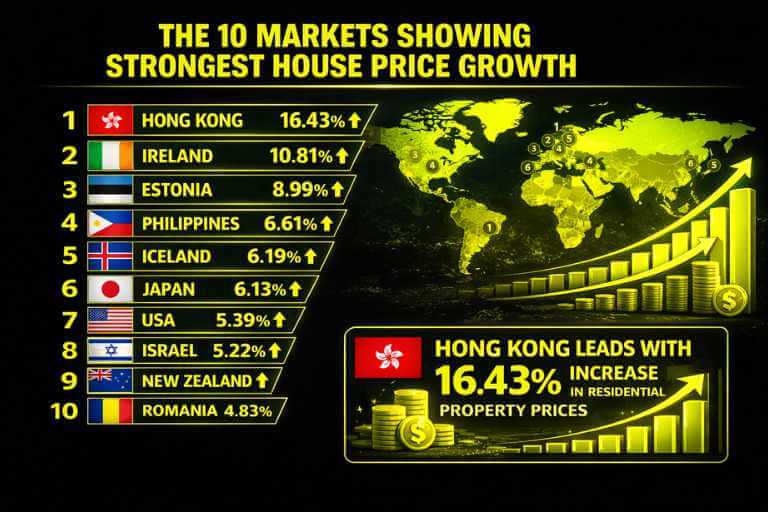
Hong Kong leads the list with 16.43pc growth in residential property prices, showing a boom at a blistering pace after bottoming out in 2013, highlighting how house prices rise rapidly in key Asian markets, while Ireland takes second place with house price growth of 10.81pc, prices rose 10.8pc in the year to end of June, according to the OECD, signaling that even in Europe, some strong European housing markets are seeing rapidly rising house prices, which authors and think tanks warn could become the biggest risks for financial stability if left unchecked.
Estonia, the second-best performer in Europe, shows the third-fastest rising housing market with 8.99pc increase in house prices last year, particularly in capital Tallinn, where average price of dwellings rose 9pc in the year to June, while Philippines saw 6.61pc, Iceland 6.19pc, Japan 6.13pc, US 5.39pc, and Israel 5.22pc, reflecting a global trend where house prices in major markets continue rapidly rising, creating opportunities but also increase vulnerabilities and indebtedness for buyers and investors.
New Zealand and Romania also feature in the 10 markets showing strongest house price growth, with New Zealand at 5.19pc and Romania at 4.83pc, while 13 of 20 European housing markets show figures available with prices levelling after recent house price rises, and other countries like Norway, UK, and Germany report more moderate growth 4pc, reflecting that Europe remains depressed overall, despite pockets of strong housing performance, according to global surveys and reports.
Meanwhile, some markets show the opposite: Russia, the second-weakest housing market, experienced the biggest annual house price decline, with residential property prices dropped 11.1pc in the year to June, Ukraine struggled due to economic crisis and political crisis, with average prices of new residential properties plunged 10.6pc and fell 1.6pc from April to June, while other weak European housing markets such as Greece, Spain, Cyprus, Croatia, and UAE, along with Dubai, saw biggest year-on-year declines with house prices steadily falling due to slump, price of oil, weaker currencies, weaker demand, and expats, showing that even in global house price growth surveys, sharp house price falls continue to affect regions differently.
Are houses more expensive in Europe or America?
It depends on the specific location. Major European cities like London, Paris, and Monaco have higher property prices than most American cities. However, prime locations in the US like New York City, San Francisco, and Los Angeles are more expensive than average European cities. Overall, Western Europe tends to have higher average property prices per square meter, but America offers larger homes. When converting foreign currency for real estate transactions between these markets, exchange rates can significantly impact affordability.
Which country has the highest property prices?
Monaco holds the title for the world’s most expensive property market, with average prices exceeding $50,000 per square meter. Other countries with extremely high property prices include:
Hong Kong
Switzerland
Singapore
Luxembourg
United Kingdom (London specifically)
Which is the cheapest country in Europe to buy a house?
The cheapest European countries to buy property include:
Bulgaria – Average property prices around €800-€1,200 per square meter
Romania – Affordable housing in cities like Bucharest
Hungary – Good value outside Budapest
Poland – Reasonably priced properties in smaller cities
Portugal (interior regions) – Bargains away from coastal areas
North Macedonia – Very affordable Balkan option
Which country has the best property market?
The “best” property market depends on your goals:
For investment returns: Portugal, Spain, and Turkey show strong growth potential For rental yields: Germany and Netherlands offer stable returns For stability: Switzerland and Singapore provide secure markets For affordability and growth: Poland, Portugal, and parts of Greece For expat-friendly options: Spain, Portugal, and Thailand
What is the cheapest country to live in the world?
The most affordable countries globally include:
Pakistan – Extremely low cost of living
Egypt – Affordable housing and daily expenses
India – Budget-friendly across most cities
Vietnam – Low costs with good quality of life
Nepal – Very inexpensive living
Bolivia – Cheapest in South America
Tunisia – Affordable North African option
Which is better to live, Europe or America?
There’s no definitive answer—it depends on personal priorities:
Europe advantages:
Universal healthcare systems
Better work-life balance
Rich history and culture
Easy travel between countries
Strong public transportation
America advantages:
Higher average salaries
More spacious housing
Lower taxes in many states
Entrepreneurial opportunities
Diverse climates and landscapes
Cost comparison: Europe generally has higher taxes but better social services, while America offers more disposable income but higher healthcare and education costs. When converting foreign currency for real estate transactions between these regions, consider not just property prices but overall quality of life, career opportunities, and long-term financial implications.




Leave a Reply